

The current stories of what defines ‘cool’ and gives people status are killing the planet. New narratives are needed to save wild species and the natural world. Will 2026 bring the needed shift?
The status-driven addiction to consumption is driving planetary collapse. At present this addiction is shared between all groups who are able to participate in consumer culture. Without being able to tell different stories about the elite groups propelling us collectively to planetary tipping points, and without creating new groups advocating an alternative based on generosity of spirit, the behaviour changes needed to pull us back from the brink cannot happen. Simply converting the energy powering unnecessary consumption from fossil fuels to renewables will never be enough, this has already been proven.
Without the rate and scale of extraction of wild species, and other natural resources, being drastically reduced we unconsciously accept that we are more reconciled to extinction than the collapse of capitalism and the end of status competition based on consumption. What is truly tragic is that much of this extraction is to create unnecessary, luxury goods that we have been groomed to consume. The desire to gain status or be perceived as cool are underlying drivers of our purchasing decisions and as such we can be, and have been, easily manipulated.
There are four key parts to this story:
- The key problem group being groomed to consume unnecessary goods and drive planetary collapse are the top 10% of earners. A recent Moody’s Analytics report shows the top 10% of earners account for nearly half of all U.S. consumer spending.
- The rest of us are groomed to fawn over them, giving them perceived status and, as a result, a mandate to continue their planetary scale destructive purchasing behaviour.
- It is in the best interest of the 0.001% to groom this mindset. Fewer than 60,000 people – 0.001% of the world’s population – control three times as much wealth as the entire bottom half of humanity.
- That doesn’t let the rest of us in wealthy countries off the hook because too many are willing to buy counterfeit goods as a result of being infected with Affluenza.
The ability to groom people to drive a capitalist economy was worked out some time ago. Adam Smith, the Scottish economist and philosopher, who pioneered the field of political economy, believed people were not driven by the hunger of wealth but what wealth could provide. He discussed that what humans want is to ‘be observed’ and to ‘be attended to’.
Mass media has ensured that social status, identity and self-worth have been increasingly linked to consumption. Such perceptions gathered speed with the internet, social media and toxic algorithms. Buying stuff continuously gets you noticed on platforms such as Instagram and TikTok. Buying luxury cars, haute-couture fashion or accessories, or an extensive property portfolio ensures that you are fawned over by millions, and in a few cases billions, of people.
As Gus Speth, an American environmental lawyer and advocate, correctly observed that, “The top environmental problems are selfishness, greed and apathy…and to deal with those we need a cultural transformation……and we scientists don’t know how to do that”.
Speth was right, there is no evidence that the facts provided by climate and environmental scientist have made any dent in the lemming mentality of high-income countries heading straight into a situation that is dangerous and stupid, especially for the future generations that many profess to love and care about. At every socio-economic level, the need for social differentiation, the desire to fit in and the fear of missing out (FOMO) has driven unsustainable consumption, from Instagram and TikTok addicts to investors.
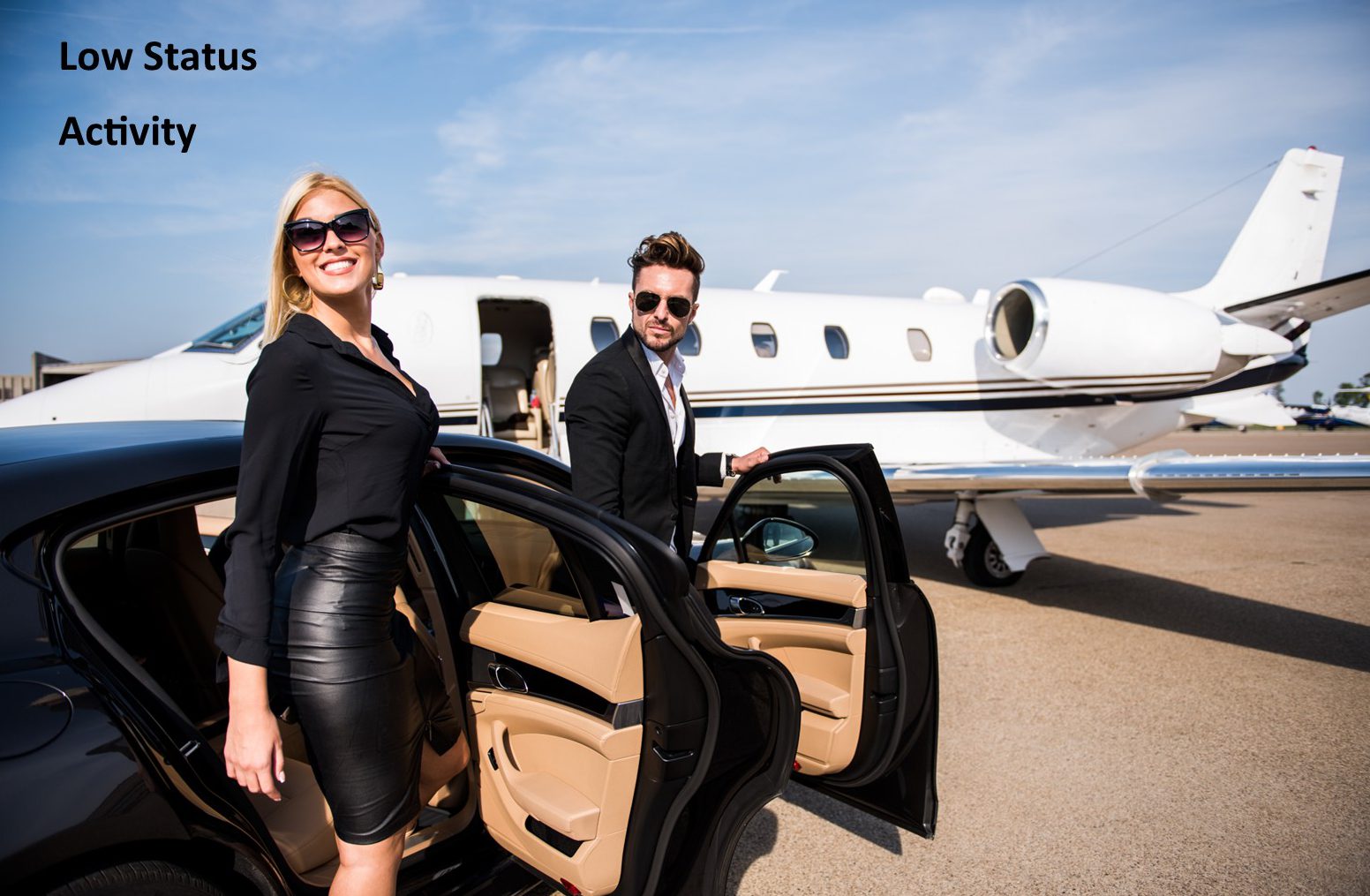
Given high income countries, and those countries’ top earners, ability to cannibalise the planet we don’t have the luxury of time to wait for people to evolve a greater consciousness and move from an ego-centric to an eco-centric mindset.
Waiting isn’t an option especially since so much research highlights this would be wasting more time as gaining wealth reduces empathy in too many people – the wealth-empathy gap.
What we can do is change the behaviours needed to gain the labels of ‘status’ or ‘cool’. Status can only be given it can’t be taken. Do we want to give status to the people whose consumption is driving us to collapse or the people who contribute to pulling us collectively back from the brink? It’s time to decide.
Where to start? Redefining Cool and Status.
It Is Time To Redefine Cool:#

A recent paper titled ‘Cool People’ summarised the results of surveying many thousands of people across Australia, Chile, China (mainland and Hong Kong), Germany, India, Mexico, Nigeria, Spain, South Africa, South Korea, Türkiye, and the United States about what it means to be a cool person. The researchers also explored the question, is being cool the same thing as being good?
Their findings were stable across countries, which suggests that the meaning of cool has crystallized on a similar set of values and traits around the globe. This is maybe no surprise given the advent of the internet. Also, no surprise is that cool and good, are not the same.
Cool people are perceived to be more:
- Extraverted,
- Hedonistic,
- Powerful,
- Adventurous,
- Open, and
- Autonomous
Good (but not cool) people are perceived to be more:
- Conforming,
- Traditional,
- Secure,
- Warm,
- Agreeable,
- Universalistic,
- Conscientious, and
- Calm.
The fact that these pattern of findings are now consistent worldwide provides an opportunity. But it is an opportunity that can go one of two ways. Currently it is heading in the direction that will drive planetary collapse, because those who profit from the current definition of cool have the funds to maintain this perception.
It is in the profiteer’s best interest to align ‘consumption’ and ‘cool’ via the behaviours perceived to be hedonistic, powerful, adventurous and autonomous.
But the reality that needs to be hidden in plain sight is that consumption is all about ‘conforming’. Conforming to the expectation set by elite consumption and all the media platforms promoting this ‘lifestyle’. What is very interesting (and useful) is that the research showed that ‘conforming’ is the trait that was seen as the ‘least cool’ in the survey.
The conforming nature of consumption is born out by the spread of affluenza, defined in the 2001 book, Affluenza: The All-Consuming Epidemic, as “a painful, contagious, socially transmitted condition of overload, debt, anxiety, and waste resulting from the dogged pursuit of more” to see how cool has been captured to maximise profit.
Maybe the 2014 film Affluenza, loosely based on The Great Gatsby, provides another insight in to how to change perceptions of cool in relation to being ‘hedonistic’, with the subtitle Filthy Rich, Morally Bankrupt. Something that can be explored in conjunction with the attitude-behaviour gap and the wealth-empathy gap.
These can provide a basis for changing what is perceived as cool. But it must also be acknowledged, as already stated, that vested interest have massive funds available to maintain the status quo, cultural practices and norms.
It Is Time To Redefine Status:#
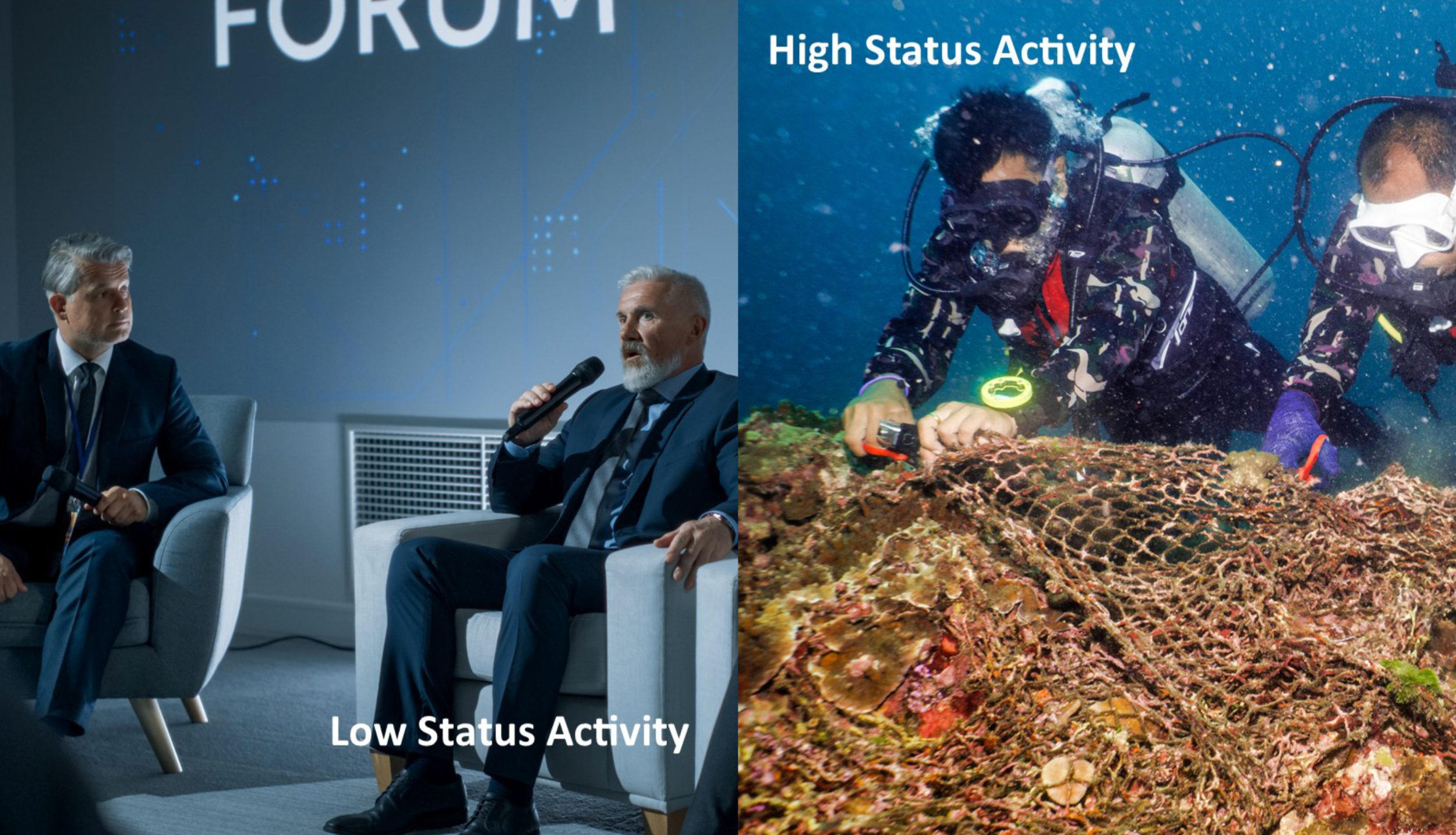
Perhaps the key, and most toxic, addiction driving planetary collapse is the addiction to status. It is in the profiteer’s best interest to align ‘consumption’ and ‘status’, and more broadly economic growth with status. As with cool, status has been captured to maximise profits.
Clive Hamilton and Richard Denniss’s 2005 book, Affluenza: When Too Much is Never Enough, they argue that affluenza causes overconsumption, “luxury fever”, consumer debt, waste, and harm to the environment.
Even more than cool, the desire for status has been groomed. Big profits can be made by addicting people to needing to be observed ad fawned over (to be attended to in the words of Adam Smith). More than ever it is important to know that addiction to consumption, and constant economic growth, isn’t an accident, society has been manufactured groomed.
Nature Needs More will explore these questions over 2026, in relation to there impacts on the consumption of wild species and ecosystem collapse.
In addition, we will consider Redefining Philanthropy, including the question, should people be seen as philanthropists when, in parallel, they hide the scale of their wealth in secrecy jurisdictions? Sadly, too many NGOs are so starved of cash they don’t question the motivations of the people giving.
Like the robber barons of the so-called guiled age, who in latter years turned to philanthropy to create a legacy diverting attention from decades of ruthless, commercial behaviour, the philanthropic giving of the current ultra-rich serves the same purpose. Distract from the destruction they are wielding on us and on the planet. Fortunately, their philanthropic giving has been so self-centred recently (with their money going mostly their own projects, such a life-extension), that it has largely ceased to serve the purpose of distraction. The perception of the ultra-rich is going down rapidly, which is a good thing.
Does this indicate that we are ready to create a different narrative or are we stuck in stories more reconciled to (our own) extinction than the collapse of capitalism? Let’s see how 2026 unfolds!