

When cultures value people conditioned to not look into its dark corners, we shouldn’t be surprised when this backfires. So, what happens when it is OK to lack curiosity until it’s not?
Watching the Westminster and Whitehall panic over the Mandelson affair, and particularly the criticism of the two key characters, Keir Starmer and Olly Robbins, over their respective ‘lack of curiosity’ at key points in the timeline, is a perfect example of such a backlash.
It comes as no surprise to read statements such as “The failures of process matter, but a series of judgment calls lie at the heart of this scandal”.
These “judgment calls” resulted in people not looking into dark corners when it was needed.
This conditioning becomes entrenched because of 3 types of feedback loops:
- What is rewarded,
- What is punished, and
- What is tolerated
What is tolerated is the most insidious.
In the case of governments, this lack of curiosity is built in and reinforces the status quo, allowing you to tolerate rather than fix the problems with the system, including problem people. One of the excuses peddled by those involved for the ‘lack of curiosity’ about the vetting process was that if they went there, it would narrow the diversity of people able to enter public life.
This is pretty much the opposite of what happens in reality. Most appointees are alumni of the elite private school system in the UK and if they aren’t from private schools, they have a financial sector background; BlackRock, Goldman Sachs or the like.
And then something backfires, as is playing out now, with Starmer and Robbins being questioned by a parliamentary committee. The implication being in the race to appease Trump, they weren’t curious enough about results of Mandelson’s security vetting.
As we watch Starmer being “mortified and furious”, and Robbins “not fully understand the reasons that I’m in the position I am in”, key is what actions will come from this, if any? Being angry or discombobulated is not the end point, or at least it shouldn’t be.
Starmer has a difficult time ahead, with it being implied he looks like “he is somehow a bystander – a witness to what happens, rather than its central character” or is “hopelessly out of touch with the detail, not interested in the actual processes of government and devoid of any political antenna”.
While the lack of curiosity doesn’t bring down governments, industries or people very often, it isn’t unheard of:
- Arthur Andersen, formerly one of the Big Five accounting firms, voluntarily surrendered its licenses to practice as a CPA in 2002 as a result of its ‘lack of curiosity’ about Enron’s accounts.
- Key financial institutions collapsed or were acquired because of their ‘lack of curiosity’ about the financial instruments they were selling or buying and about the combined actions of the industry players in creating unsustainable debt. The most well-known being Lehman Brothers but there were many more including Bear Stearns and Merrill Lynch.
- The UK royal household’s ‘lack of curiosity’ of the personal and business ‘dealings’ of Jeffrey Epstein brought down a prince.
But, in the main the lack of curiosity is built into systems to perpetuate the status quo; it drives conformity and allows participants to focus on status competition instead of achieving the outcomes the institutions were originally created for.
This “judgment call” to “lack curiosity” also plays out in the conservation world. It is a lack of curiosity about the industrial scale legal commercial extraction of endangered and exotic species. It is the lack of curiosity of doing any investigation to prove that the ‘sustainable use’ model is valid.
An example of this ‘lack of curiosity’ of the commercialisation of wild species comes from the website of possibly the most well know conservation organisations, WWF.
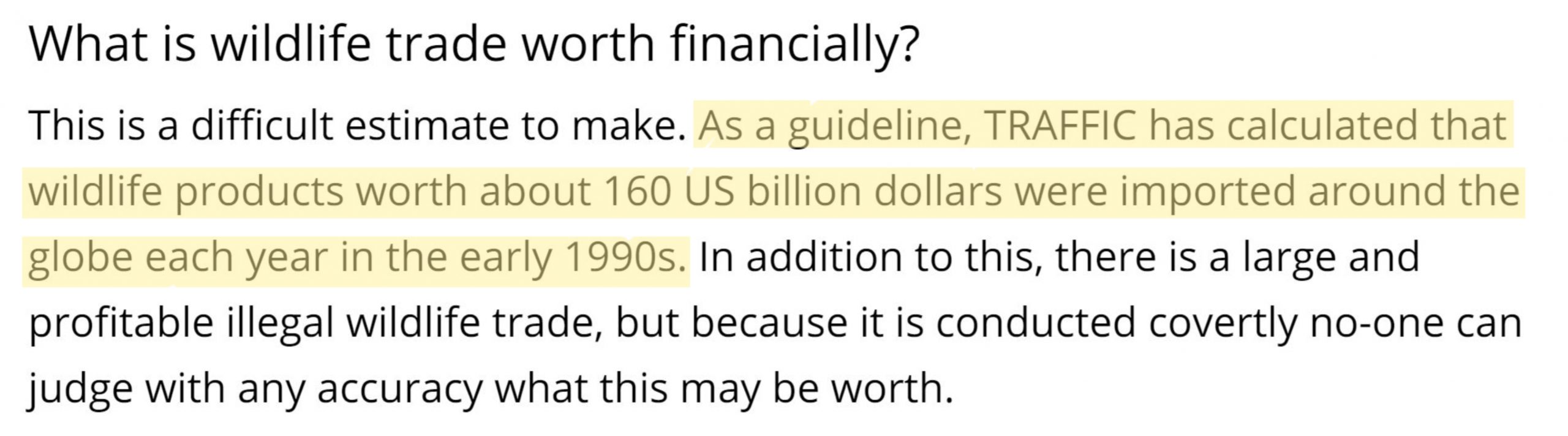
The lack of curiosity means the organisation quotes information 30 years out-of-date, which hardly fulfils WWF’s mantra of an evidence-based approach!
I did email one of their directors about this, their reply, “If you’ve got stats that hold more gravitas pls do send them through”. The lack of curiosity is indeed curious.
But this lack of curiosity about the industrial scale legal commercial extraction of endangered and exotic species is systemic throughout the conservation industry.
As with the race to appease Trump, which resulted in key people not being curious enough about results of Mandelson’s security vetting, the conservation sector appeases its political and business donor’s addiction to profit and growth by demonstrating a lack of curiosity about sustainability and legality when it comes to this trade.
The overwhelming majority of conservation NGOs and scientists support the ‘sustainable use’ model, but they are not curious about how or if it works, or indeed that it doesn’t! Their support is an act of faith and wishful thinking because conservation scientists are not actively publishing any proof that this extraction is sustainable.
This was clarified (again) in 2024 with the study, The Positive Impact Of Conservation Action. The paper, which had 33 authors, conducted a meta-analysis of scientific studies on the impact of conservation interventions. Their starting point was a scan of over 30,000 potentially relevant publications covering conservation interventions globally over the past century.
One type of conservation action they analysed was the sustainable use of species; yet the finding on the impact of sustainable use interventions was ‘inconclusive’. Why? The major issue was that this meta-analysis could find only 5 publications related to the sustainable use of species that it could use.
Five publications from a starting point of 30,000 leading to the conclusion that the results of the sustainable use model were inconclusive, and confirming a systemic lack of curiosity on one of the key drivers of biodiversity loss.
The IPBES established that trade is the biggest extinction risk for marine species and the second biggest risk for terrestrial and freshwater species. It further established that international trade is the major culprit for unsustainable extraction, not community use or local trade. Yet the conservation world is not curious about this factor.
Even businesses have demonstrated more curiosity on this issue. In a 2020 global survey, 65% of business respondents admitting they knew or suspected green crime in their supply chains.
Maybe businesses are comfortable in admitting this as they know they won’t face any consequences. This is evidenced by only 16% of global business respondents, in the same survey, saying that they would report suspicious findings externally. They know that external scrutiny is not likely to expose these supply chain crimes.
Business is so confident about the lack of curiosity of the conservation sector that, “63% of [business] respondents agree that the economic climate is encouraging organisations to take regulatory risks in order to win new business”.
So, what might be the results of this lack of curiosity? The consequences for Starmer’s leadership could be swift depending on Labours performance in the May local elections.
The consequences for the global conservation sector may take some time. But 2030, the deadlines for achieving the KMGBF targets and goals could finally expose the conservation world’s lack of curiosity of industrial scale legal commercial extraction of endangered and exotic species.
Nature Needs More has for some time stated we are 100% certain that there is No Chance of achieving Target 5 – that trade is sustainable and legal – by 2030.
Given none of the decade long Aichi Targets were achieved by 2020, I am curious to see if the conservation world, in its current form, can survive a second decade of complete failure because it refused to look into the dark corners of biodiversity loss associated with the industrial scale legal commercial extraction of endangered and exotic species.
I am sure when the time comes many in the sector will be angry or discombobulated. But this is not enough and it shouldn’t be the only consequence.