

Watching HSBC’s mini-documentary, Monkey Busine$$, about the bank’s work to expose financial crime linked to the illegal wildlife trade, triggers the question, have we reached peak hypocrisy?
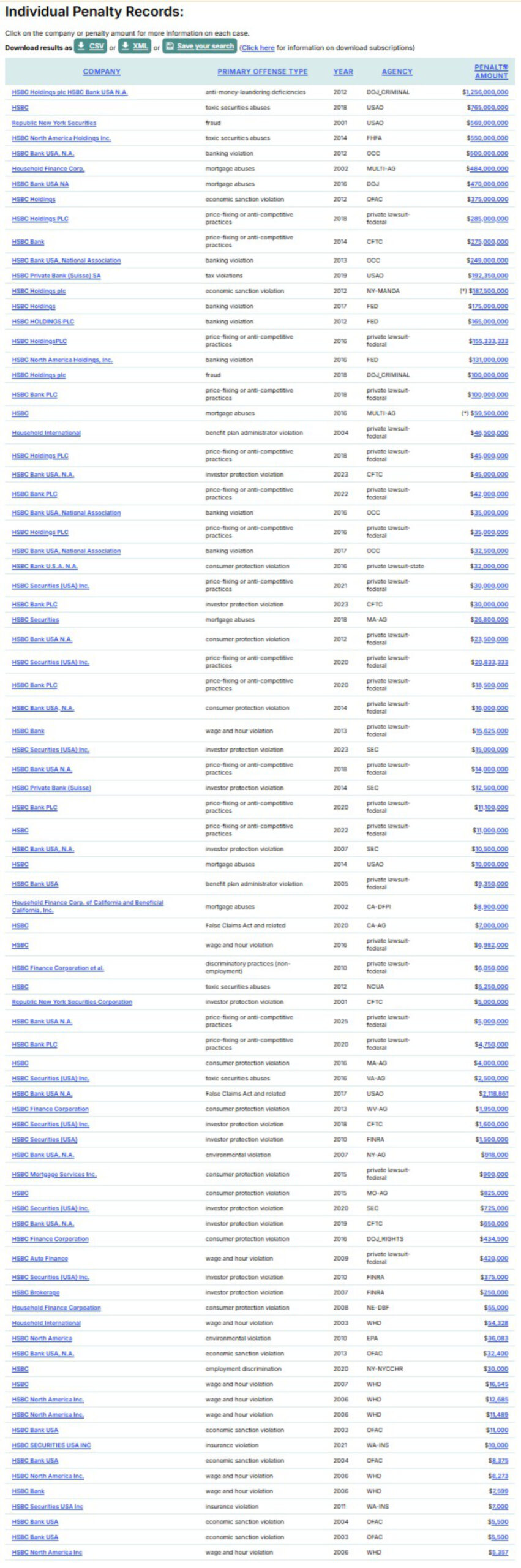
This is not just about the company, but let’s start there, with the long list of HSBC’s penalties and fines for everything from anti-money-laundering deficiencies, fraud, banking violations, and the list goes on. And these aren’t historic violations – 15 penalty records are noted between 2020 and 2025.
None of these violations are hard to find. Which begs the question, what due diligence was done before United for Wildlife agreed to appear in this HSBC promotional video?
It isn’t unusual these days for conservation organisations to seek collaborations with companies in the naïve belief that being on the ‘inside’ they can inform commercial decisions. The evidence of declining biodiversity is that the only seat at the table NGOs were ever offered is nothing but a highchair.
But let’s face it this isn’t any NGO, this is Prince William’s United for Wildlife, a part of the Royal Foundation of the Prince and Princess of Wales. The ‘tone from the top’ has influence and as such must set a high bar rather than being a part of the reputation laundromat.
This feels like the equivalent of seeing Greta Thunberg in a fossil fuel company promotional video talking about how they are helping to reduce global warming!
Investing just one hour to watch the 2017 documentary HSBC: The Money Laundering Scandal probably should have been enough for any NGO to stay clear of the bank’s promotional video about how they are helping expose money laundering linked to wildlife crime.
The 2017 HSBC money laundering documentary outlines the story of when in 2012 criminal charges were filed in the USA against HSBC Bank for, “its sustained and systemic failure to guard against the corruption of [the US] financial system by drug traffickers and other criminals and for evading US sanctions law”.
In the documentary, former Deputy Federal Prosecutor, Richard Elias, states, “Affiliates of drug cartels were literally walking into bank branches with hundreds of thousands, sometimes millions, of dollars of US cash, in Mexico, and putting it through the teller window, sometime in boxes that were specially designed to fit through the teller window. And the HSBC employees took it, they deposited it and gave the person a receipt and never reported the conduct and never stopped it. And that didn’t happen once, it didn’t happen twice, it happened systematically over the course of about a decade. There was one occasion, an individual walks into the bank with maybe US$3-4 million dollars and bank employees spent one full day counting it”.
Richard Elias goes on to say, “The bank had been warned repeatedly and consistently by US authorities and by Mexican authorities. They also were told that the US Prosecutors “had recordings from drug lords that said HSBC was The Place to launder money. London knew everything and they just didn’t care”.
As a result, HSBC was at risk of losing its licence to operate in USA. In an effort to protect the bank and the City of London, then Chancellor of the Exchequer, George Osborne, lobbied the Obama administration on behalf of HSBC; the bank escaped trial. It received a large fine, which Jack Blum, Jurist and former US Senate investigator, calls, “the equivalent of a parking ticket” for the bank.
In the documentary, Jack Blum also says, “This bank had done everything bad that a bank can possibly do… If you don’t prosecute these people, who the hell are you going to prosecute?”.
The British establishment went in to help HSBC in 2012. Some might say that a United for Wildlife representative appearing in the HSBC video is a simple continuation of the British establishment continuing to protect its own by helping to rehabilitate a brand.
After all, if participating in this HSBC promotional video was seen as a poor decision by Prince William’s charity surely United for Wildlife’s Co-Chair, William Hague, would have advised against this? William Hague, served as First Secretary of State and the Foreign Secretary over the period when criminal charges were filed against HSBC and investigations into the bank’s operations were happening.
But the hypocrisy doesn’t stop there. While the HSBC Monkey Busine$$ video does highlight that long tailed macaques are the most traded primates, the imagery in the video is highly suggestive that demand comes from ‘pet shops’ in Asia, which is completely misleading. Beyond the imagery used, the video is eerily quiet about where the demand comes from.
By far the biggest importer of live macaques in the lead up to the 2022 incident discussed on the video was the USA. In fact, the arrest discussed on the video was that of Kry Masphal, the Director of the Cambodian Forestry Administration’s Department of Wildlife and Biodiversity; he was arrested for allegedly smuggling wild-caught and endangered monkeys into the U.S. for biomedical research.
When the Director of United for Wildlife, Rob Campbell, states in the HSBC promotional video, “the macaques in this case were being stripped from the wild. Chucked in a box. Many of those species will die on route to wherever it’s going”, the fact that the USA was the primary importer for macaques at the time wasn’t made clear.
The US biopharmaceutical industry, an industry valued at $586 billion, is a key user of macaques for animal testing of drugs. US imports were suspended, after the 2022 arrest but the biopharmaceutical industry simply found a work around – Canada.
In the end, a Florida court has acquitted Kry Masphal, despite almost 100 items of evidence entered into the court by the prosecution — including videos, WhatsApp messages and emails. Hardly the wildlife trafficking success story alluded to in the HSBC promotional video.
Macaques are also used for animal testing by pharmaceutical companies in the UK. A 2023 article for the Ecologist Magazine, The UK is Failing Macaques, reported on the trade in macaques into the UK and detailed how difficult it was to reconcile the numbers actually entering the UK via CITES export/import permits.
In the article, the Long-tailed Macaque Project’s Malene Hansen said, “The discrepancy level is through the roof”, continuing, “We are trying to monitor here but we actually don’t know exactly what’s going on”. Born Free’s head of policy, Mark Jones said, “If the data the UK is collecting does not enable meaningful trend analysis, you have to wonder what its purpose is”.
The Ecologist article further highlighted that macaques are probably one of the easiest to CITES listed species to count and should be microchipped before export – yet none of the import numbers into the UK from CITES records, HMRC and the Quarantine Authority (APHA) agree.
Growing public awareness of biodiversity loss means businesses are also aware that they need to do something – anything – to prepare for when their years of greenwashing are going to be challenged. This is the point we are at, and industry will now try to slow the regulatory change needed. This is a well-worn strategy, not only with tobacco and fossil fuels.
Take the example of the asbestos industry. When the UK government was looking at developing new asbestos industry legislation in 1969, they invited representatives of the industry to be a part of the discussions. As the BBC investigation Killer Dust highlights, an internal memo at the time indicated that they believed, if they showed a token effort at compliance, “it is conceivable that we can ‘ward off the evil day’ when asbestos cannot be economically applied”. It worked, asbestos products were still being sold decades later.
Just how many companies profiting from the trade in wild species are using the strategy of showing a ‘token effort’ to ‘ward off the day’ when mandated, well-resourced regulation will be demanded to save the little that is left?
As another United for Wildlife initiative states, yes, wildlife is everyone’s business, but it is frankly ridiculous to imply they are ‘our’ flight routes, ‘our’ shipping lanes, ‘our’ technologies and ‘our’ financial systems. Unless they are nationalised, ‘we’ don’t run them, businesses do on behalf of their shareholders, with all the privilege shareholder primacy brings. But we can push our governments to rebuild mandated and well-resourced regulatory systems.
Conservation agencies have completely lost their moral compass if they support the business and political establishment to protect entrenched interests, preserve the status quo and maintain the power to prioritise profits at all costs.
Regulating the wildlife trade is neither hard to do nor does it require the end of capitalism. It does require remembering that we had previous periods where certain industries were subjected to drastic regulation as the result of a crisis.