

Periodically new research or a news article exposes (again) why Nature Needs More was established in 2017: to lobby for system change to protect the tens of thousands of wild species caught up in international trade.
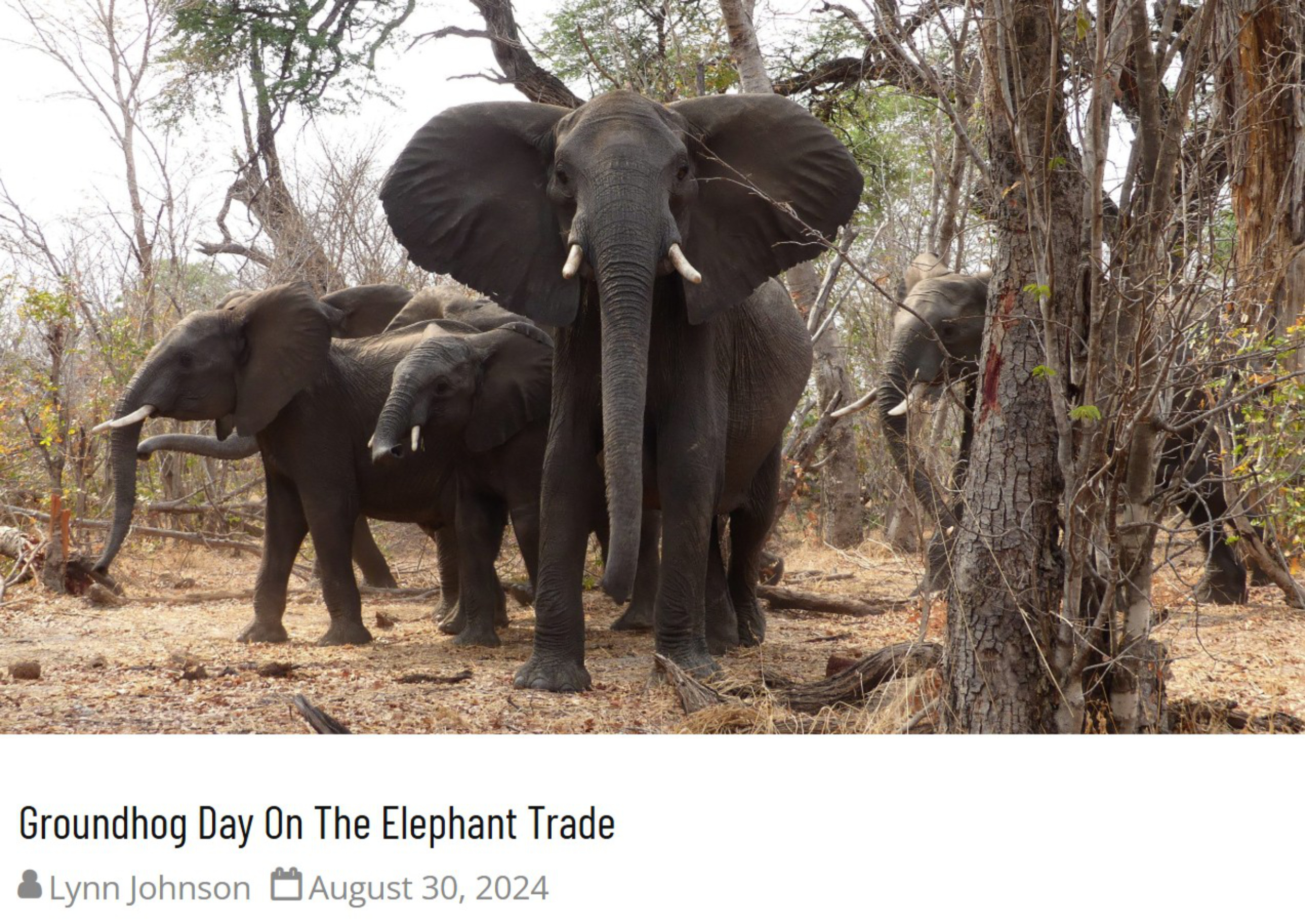
Last week, Closing the Border on Australia’s Domestic Elephant Ivory Trade, reconfirmed what the Australian Government has been unwilling to confront: Australia remains an international outlier, one of the few wealthy CITES countries without a comprehensive domestic ivory-market closure, despite efforts to close such markets dating back to 2016.
And elephant ivory is not the only problem.
As far back as 2012, European authorities identified the “road to Australia” as an important corridor for illegal rhino horn, following a dramatic increase in applications to re-export mounted rhino horns from Europe to destinations including Australia, China and Hong Kong.
These are not new problems.
From Breaking The Brand To Nature Needs More
By 2017, I had reached a simple conclusion: the illegal trade in endangered and exotic species cannot be decisively tackled while the legal trade system remains full of loopholes. That conclusion came from two projects.
Rhino Horn
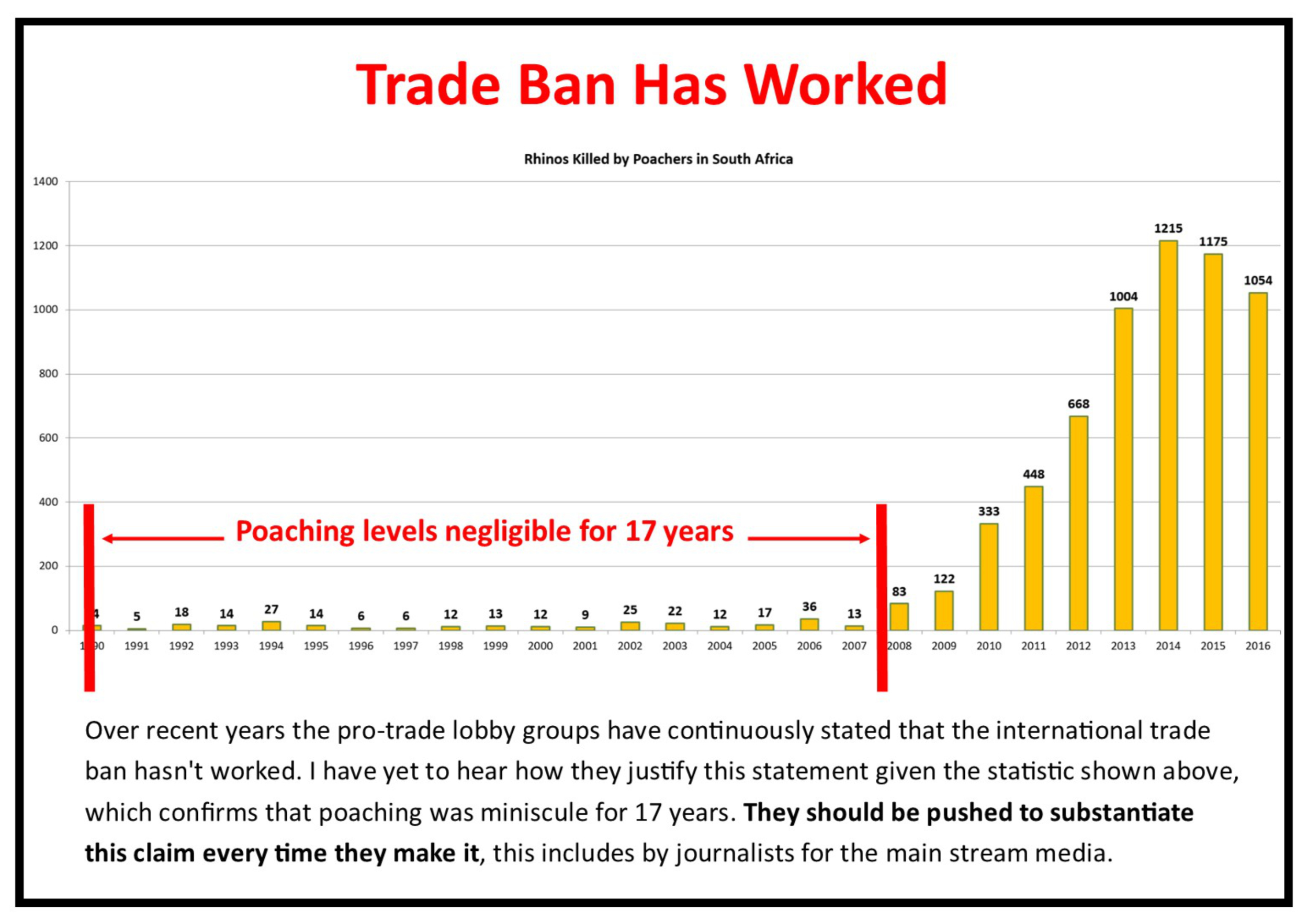
After the end of the rhino wars of the 1980s, poaching remained relatively low for many years. Yet from around 2005, governments and private rhino owners began building momentum for reopening an international trade in rhino horn, led primarily by South Africa.
The argument was that farmed horn could satisfy demand and reduce the poaching of wild rhinos. But where was the evidence?
No credible consumer analysis demonstrated that users in Southeast Asia would switch from wild to farmed horn. No genuine business plan demonstrated how international trade in farmed horn would stop—or significantly reduce—the poaching of wild rhinos.
Twenty years later, we are still having essentially the same debate. At the expense of the rhino.
Elephant ivory and rhino horn in Australia
At the same time, I was part of a team lobbying for an Australian domestic ban on elephant ivory and rhino horn. As the numbers person, I examined the CITES trade data between the UK and Australia. The results were startling.
Between 2010 and 2016, CITES data recorded:
- 2,953 Elephantidae specimens exported from the UK to Australia
- 3 specimens imported into Australia from the UK
- 2,950 units unaccounted for
Where did they go? No one has ever been able to explain it.
If the CITES system could not provide basic transparency between two wealthy countries trading in two of the world’s most iconic species, what chance did it have of regulating trade in tens of thousands of less visible (less iconic), commercially valuable species?

The more I examined the legal trade data, the worse it became.
And that was when the real problem became clear.
The conservation challenge was not simply poaching. It was a legal trade system so obsolete and impoverished that legal and illegal trade had become functionally inseparable.
The most disturbing part was that these weaknesses were not particularly difficult to find.
So why had the conservation world spent decades looking elsewhere?
Researchers produce papers. NGOs produce submissions. Governments produce strategies. Yet fundamental weaknesses in the legal trade system, weaknesses that leave it vulnerable to laundering and fraud, are repeatedly sidestepped.
You cannot miss a hole this large in a system for 50 years by accident.
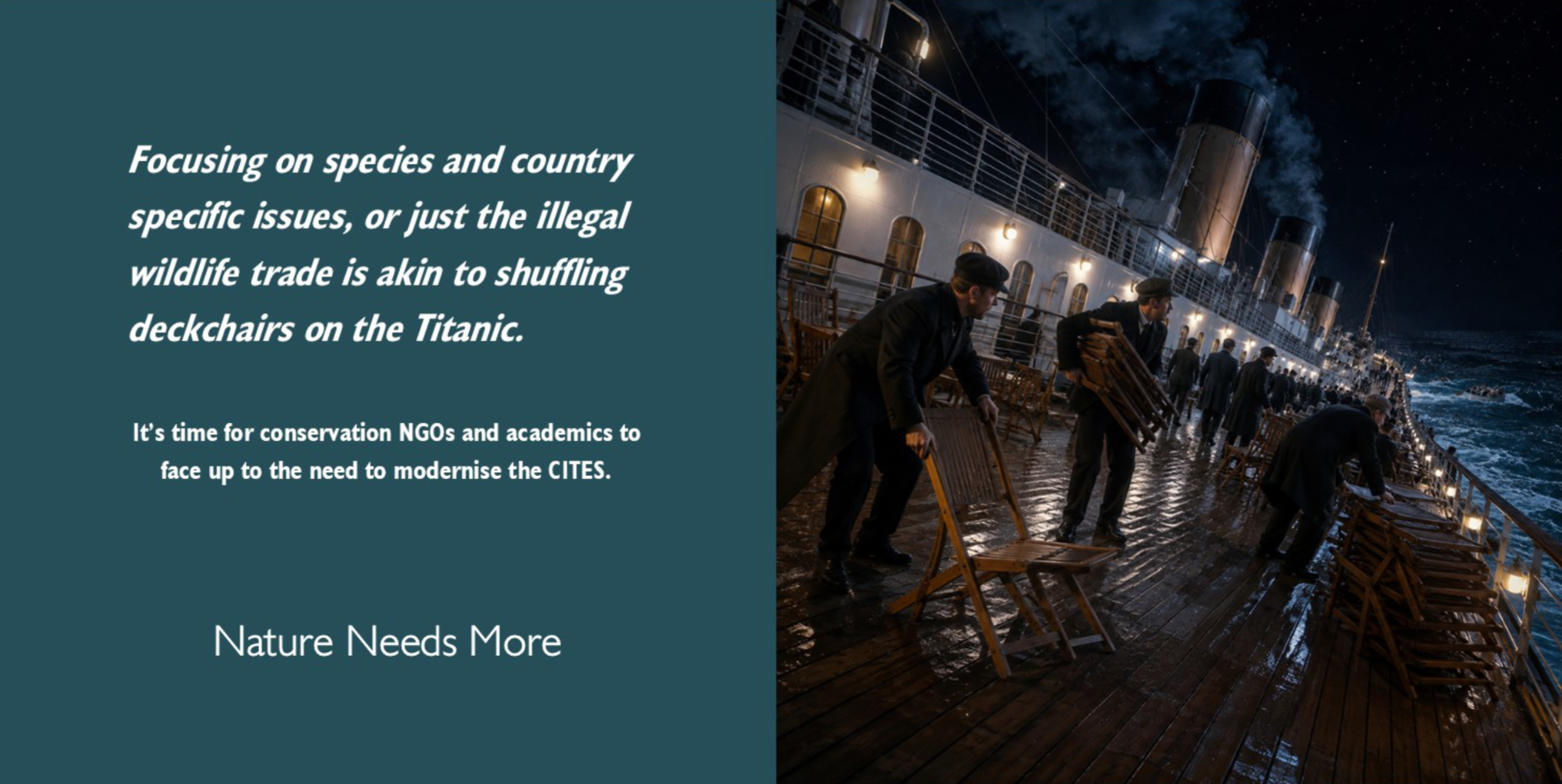
Focusing almost exclusively on individual species, individual countries or the illegal trade while ignoring the machinery governing legal trade is conservation’s version of shuffling deckchairs on the Titanic.
Why Nature Needs More
Nature Needs More was established to lobby for four fundamental changes.
Modernise CITES
CITES has failed to keep pace with the scale and complexity of international wildlife trade. It needs a strategic review and modernisation capable of monitoring today’s, and tomorrow’s, trade. Enforcement authority, for example, should be mandatory rather than optional for signatories.
Reverse the burden of proof
Trade in wild species should move to a reverse-listing model, first proposed at CITES CoP3 in 1981. Those seeking to trade should have to demonstrate, before trade is permitted, that they have the governance systems to ensure legality and sustainability throughout the supply chain.
Make trade radically transparent
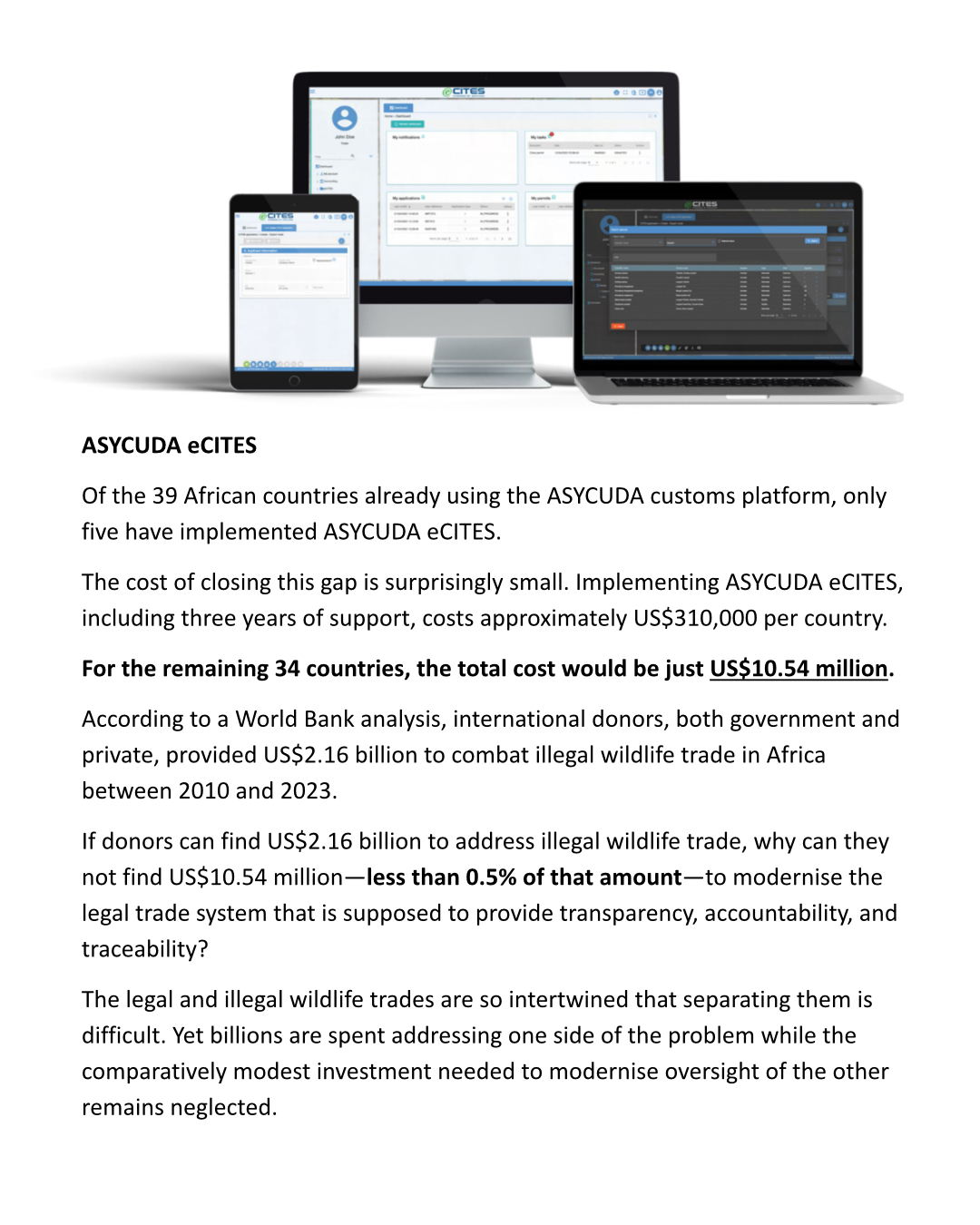
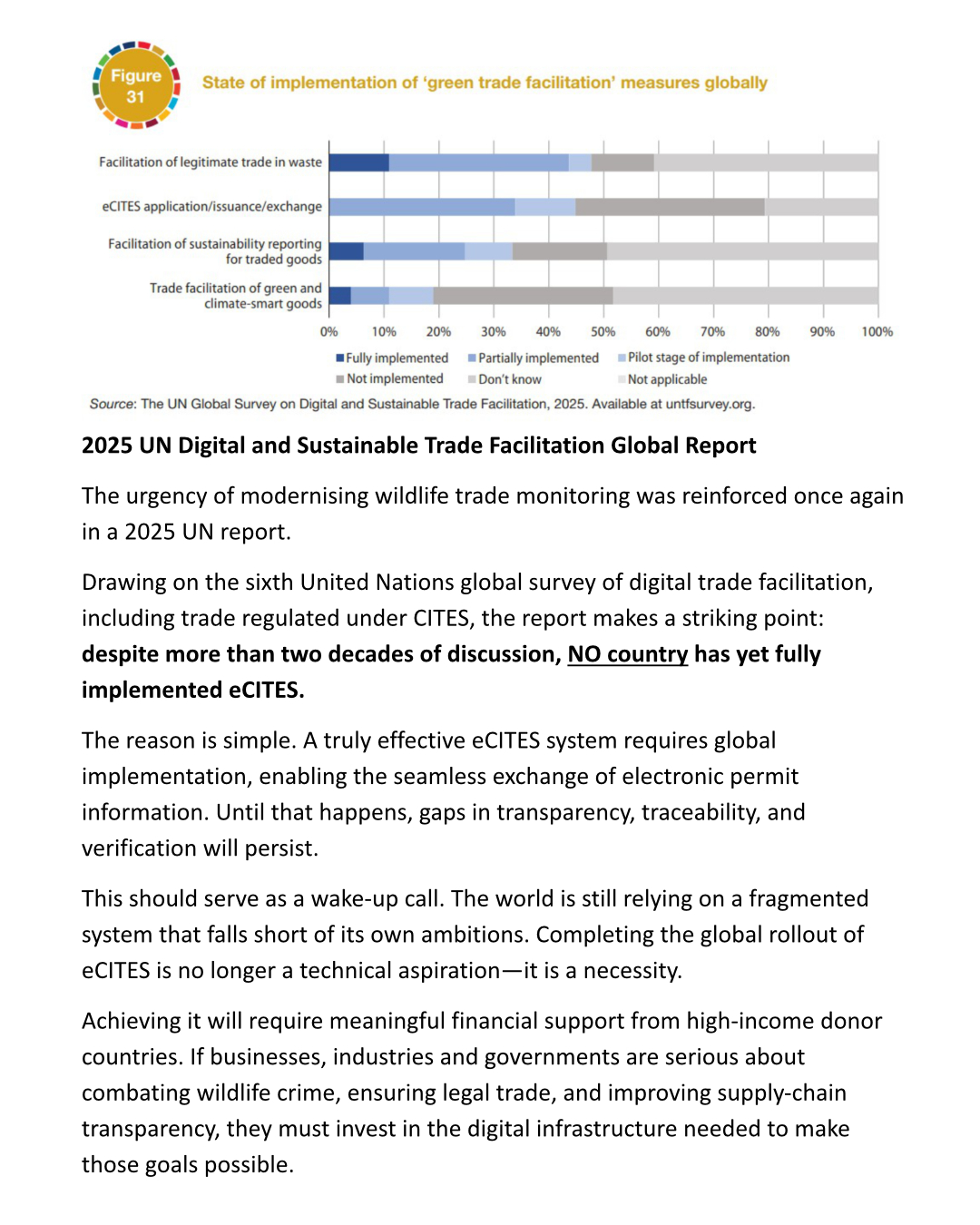
In an era of big data, a paper-based permit system is indefensible. CITES trade should be digital, traceable and capable of real-time monitoring, with loopholes that enable illegal specimens to be laundered into legal markets closed.
Make trade pay for the system
A 1% levy on the value of imported trade could fund CITES’ core operations, conservation projects, and enforcement and prosecution capacity in source countries.
Our work on system change continues across both CITES and the Convention on Biological Diversity.
Conservation’s Comfortable Compliance
After years of pursuing this agenda, another problem has become impossible to ignore. Conservation is comfortable with conservation projects. It is not comfortable with system change. The incentives point elsewhere.
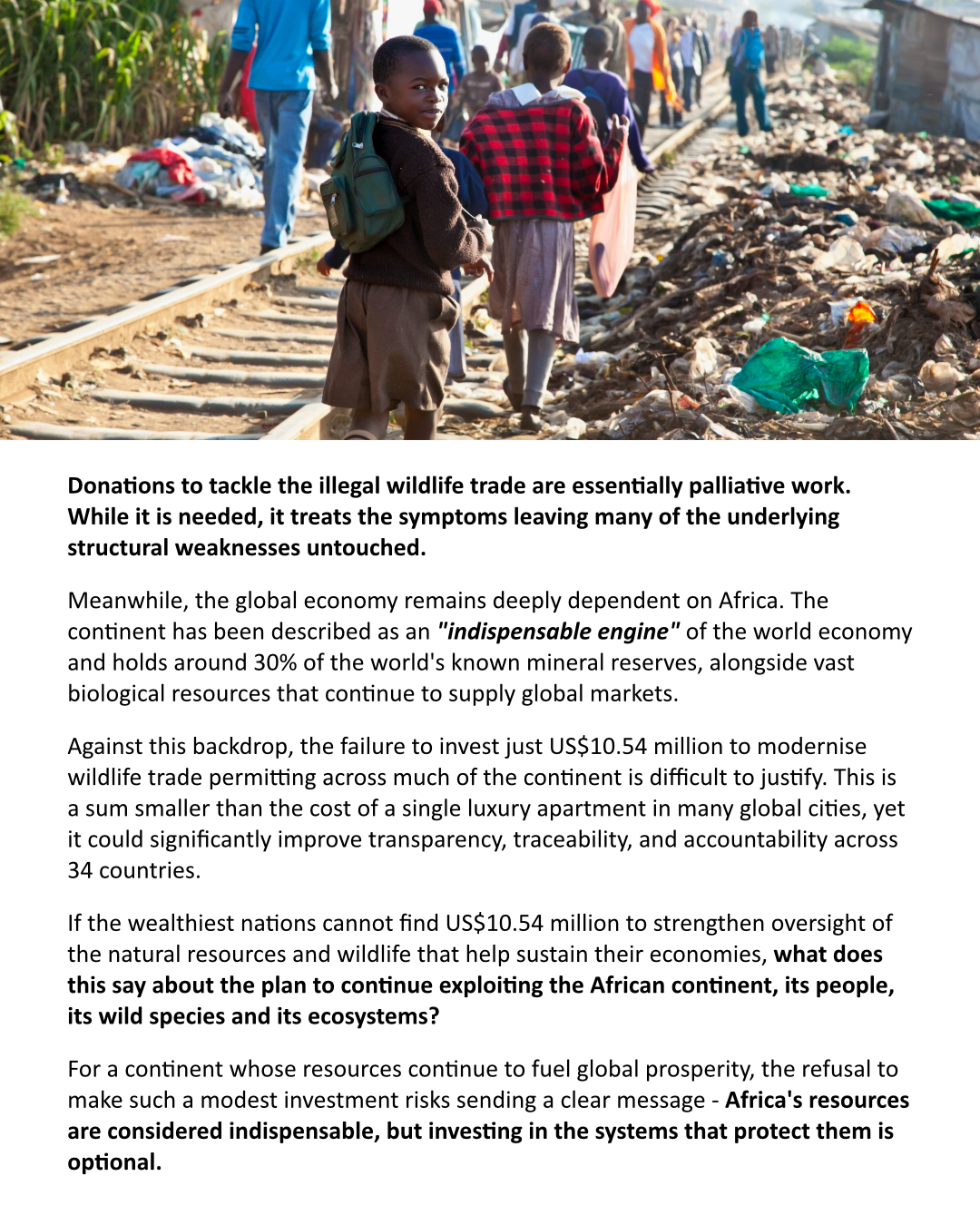
Funding is available for iconic species and anti-poaching projects. It is far harder to fund structural reform.
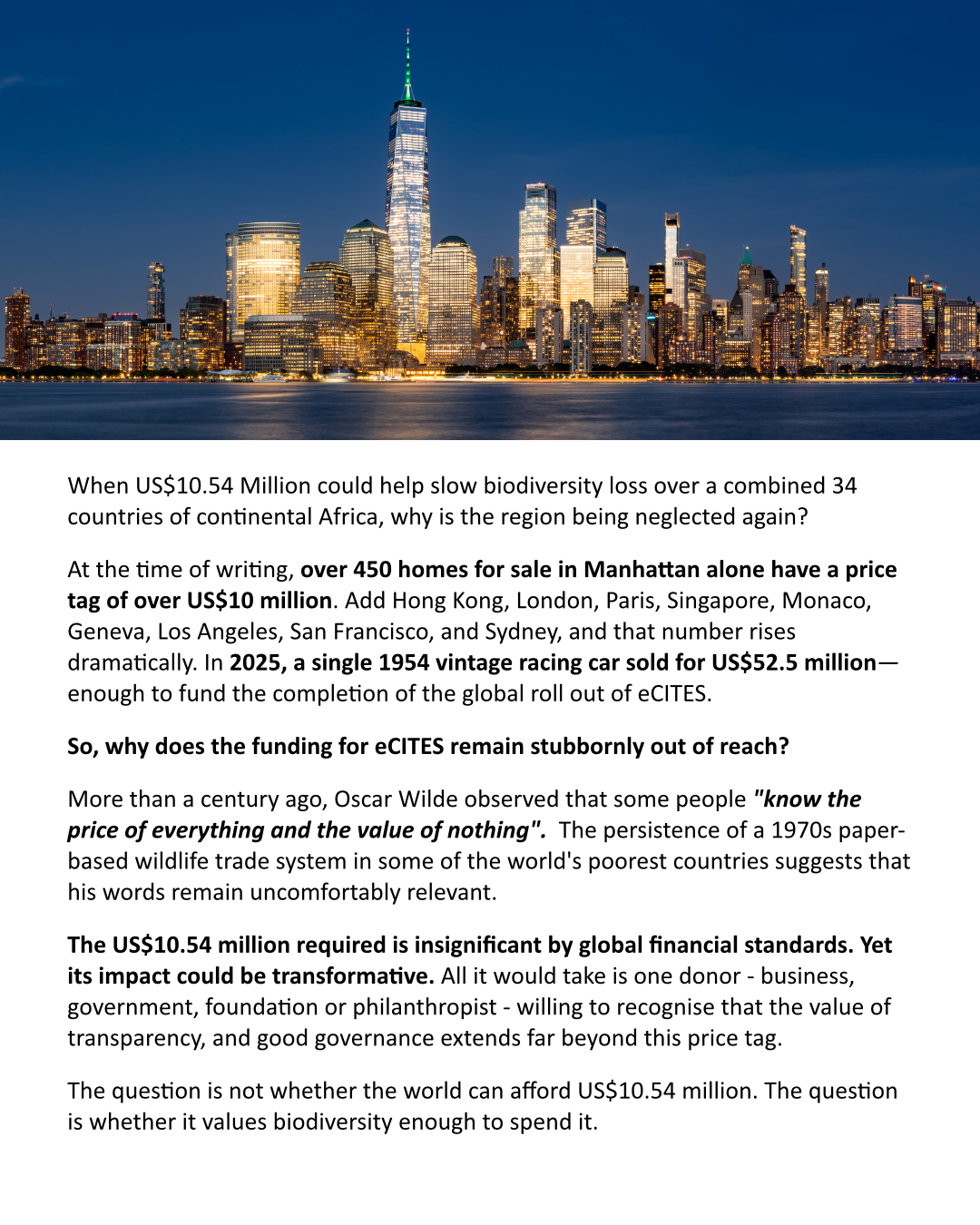
A World Bank analysis found that international donors—government and private—provided US$2.16 billion to combat illegal wildlife trade in Africa between 2010 and 2023. Yet modernising the legal trade system would require an estimated US$10.54 million—less than 0.5% of that amount.
Billions can be found to address the illegal side of the problem while the comparatively modest investment needed to modernise the system governing legal trade remains neglected. That is not a lack of money. This isn’t rational but it is by design.
The same pattern exists in the media. An elephant being rescued, a rhino being poached or a trafficker being arrested is a story. Reforming CITES is not. As journalists have told me: “Our readers wouldn’t be interested in this.”
And politically, saving an iconic species is easy to sell. Changing the machinery that governs international trade, and potentially challenging economic growth, is not.
The result is a conservation model that repeatedly funds what is visible, familiar and politically palatable: iconic species, anti-poaching, habitat projects and poverty alleviation. What it struggles to fund—and therefore struggles to confront—is the system generating the problem.
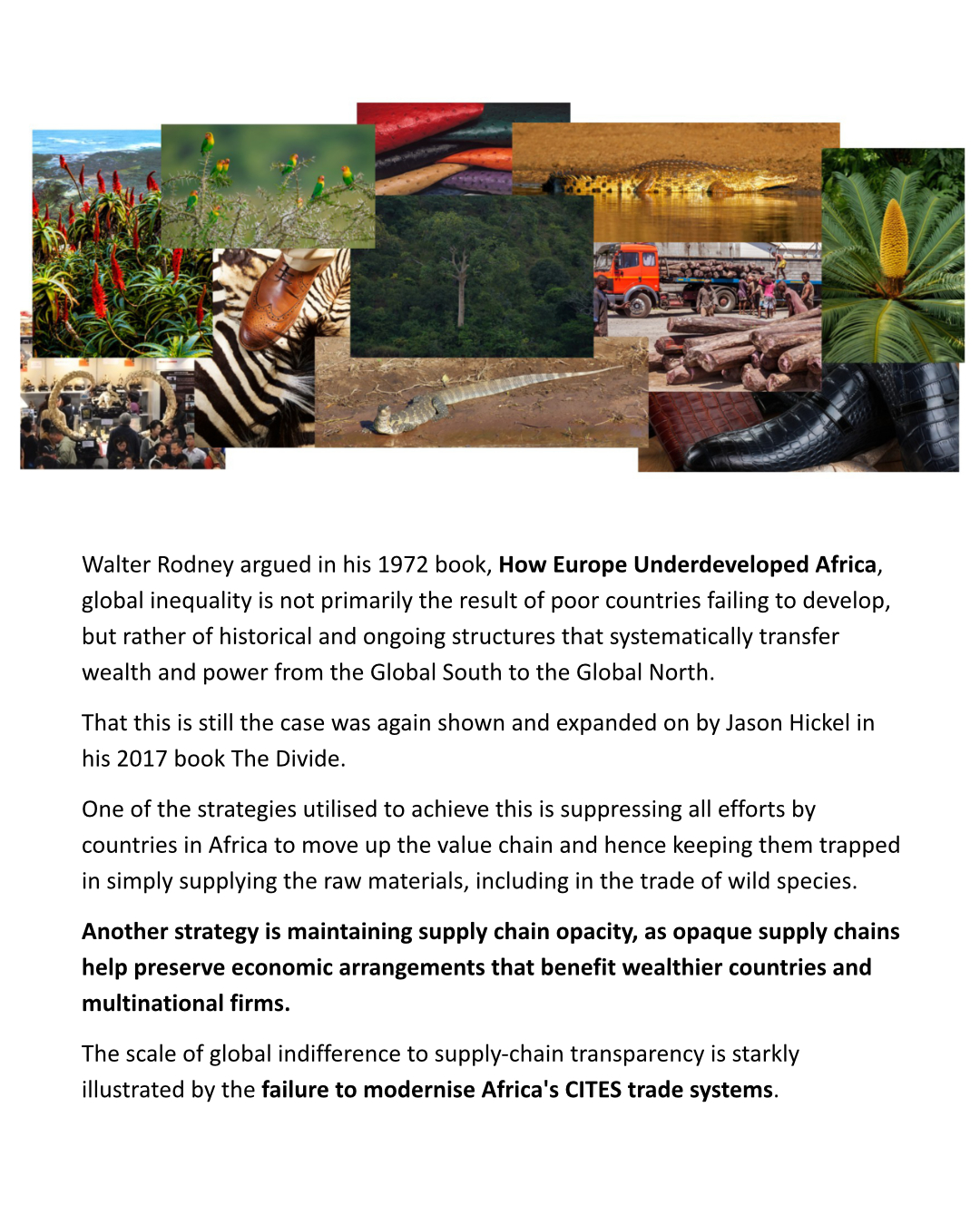
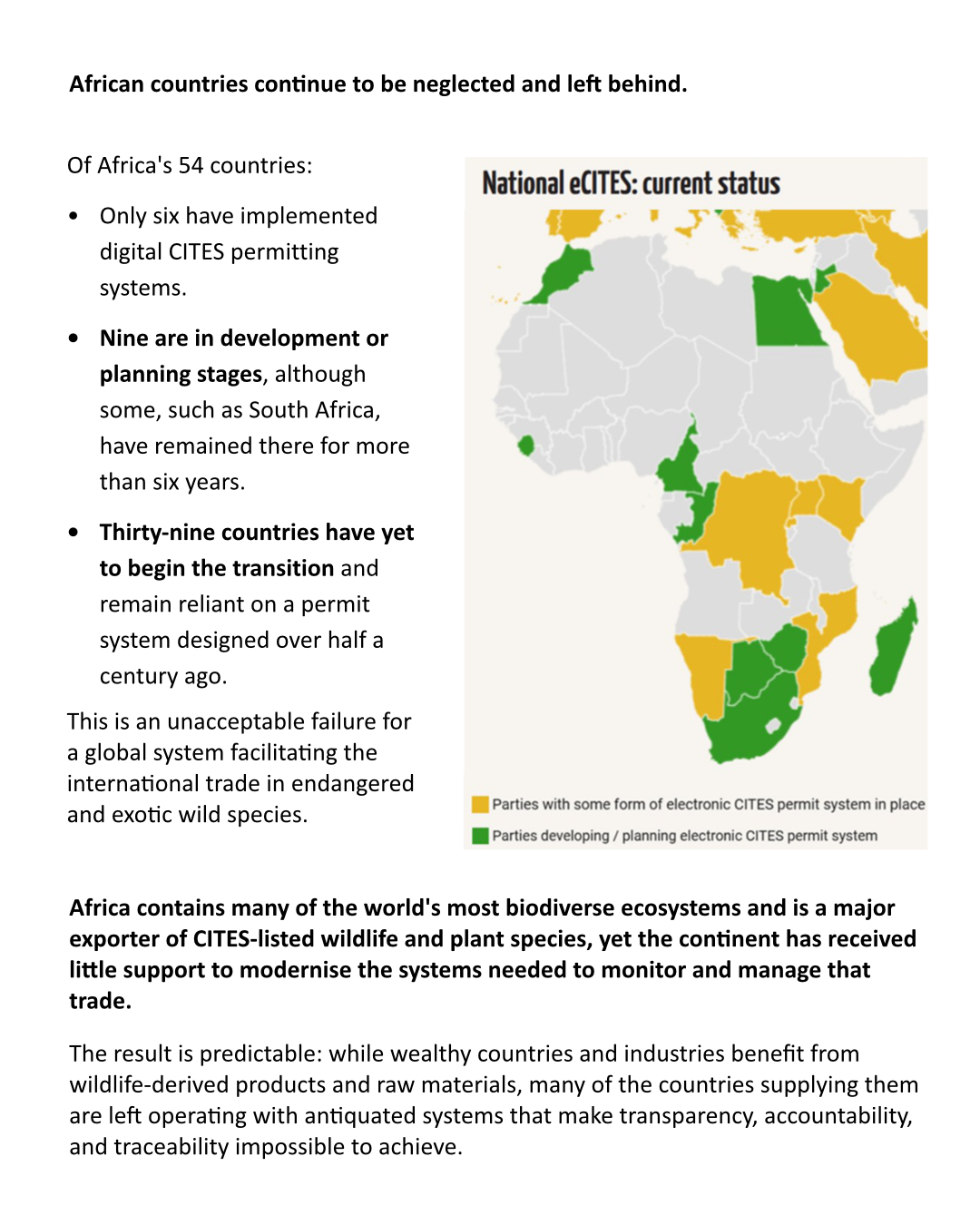
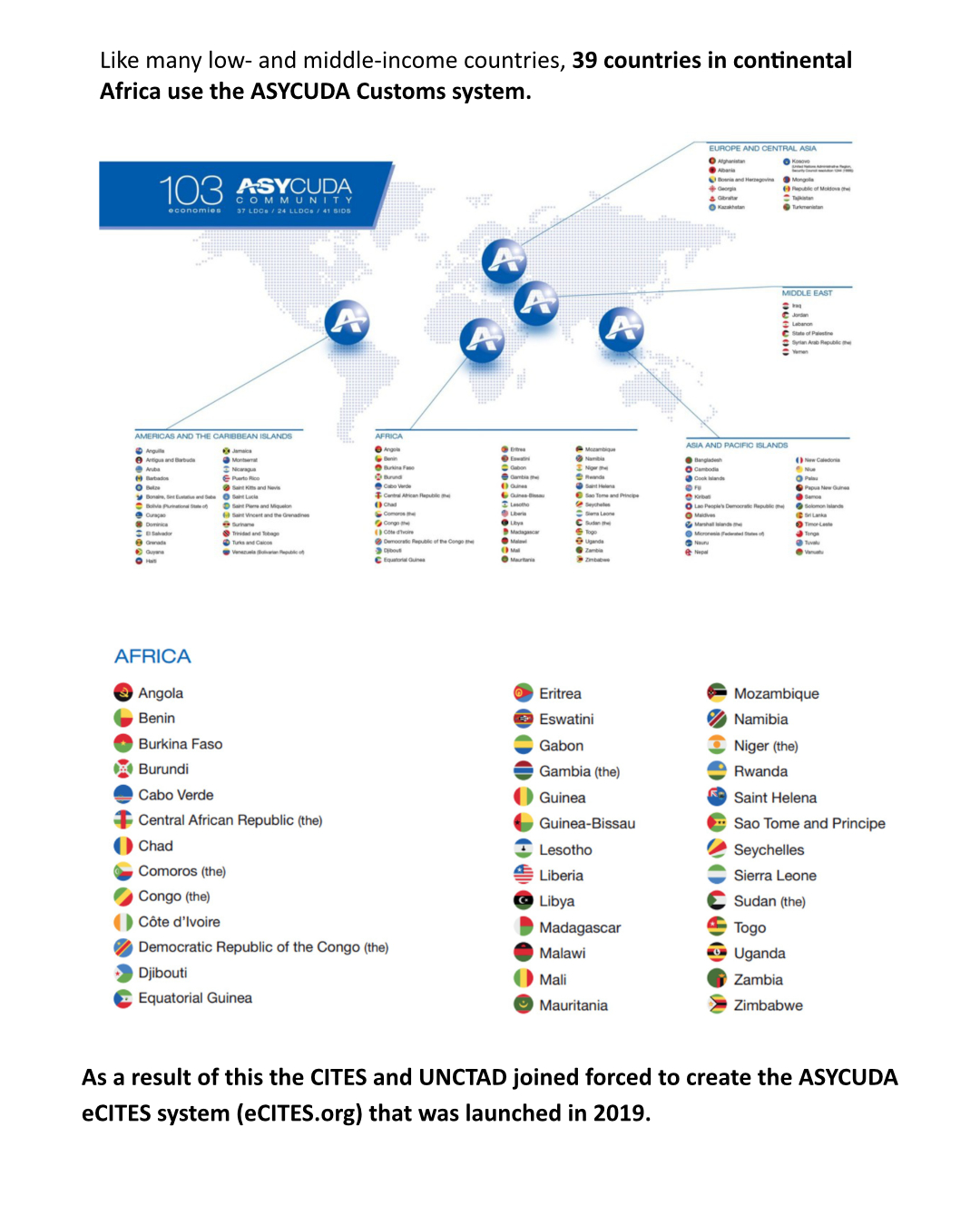
Rhino Horn: The Debate That Never Ends
For more than 20 years, the international debate over rhino-horn trade has gone around in circles.
Again and again, Southern African countries have sought to reopen international trade. At CITES CoP20, Namibia made the latest submission.
The remarkable part is not simply that these proposals continue.
It is that the system does not require the fundamental proposition behind them – that trade can be sustainable and legal—to be demonstrated first.
The argument rests on the presumption that regulated international trade can constitute “sustainable use” under CITES, despite the absence of convincing evidence that current trade in tens of thousands of listed species is sustainable.
A 2024 meta-analysis, The Positive Impact of Conservation Action, reviewed more than 30,000 potentially relevant publications. For sustainable-use interventions, the evidence was inconclusive, with only five publications meeting the criteria for inclusion.
That is not an isolated finding.
A 2021 study, Impacts of Wildlife Trade on Terrestrial Biodiversity, examined 1,807 peer-reviewed articles and more than 200 TRAFFIC reports and found “no support for a quantified, existing sustainable trade.”
The CITES-commissioned IPBES Assessment Report on the Sustainable Use of Wild Species, drawing on more than 6,000 studies, reached a similarly uncomfortable conclusion: international trade is associated with overexploitation, while the enormous expansion of international trade has contributed to increasing unsustainable use.
Yet the fundamental assumption remains.

The burden of proof is still not where it belongs: on those seeking to extract wild species for profit.
Countries can therefore continue proposing new international markets without first demonstrating that trade will be sustainable, legal and enforceable throughout the supply chain.
Whether a proposal is eventually rejected is almost beside the point.
The system does not require the proposition to be proven before it is considered.
Elephant Ivory and Rhino Horn: Australia’s Domestic Trade
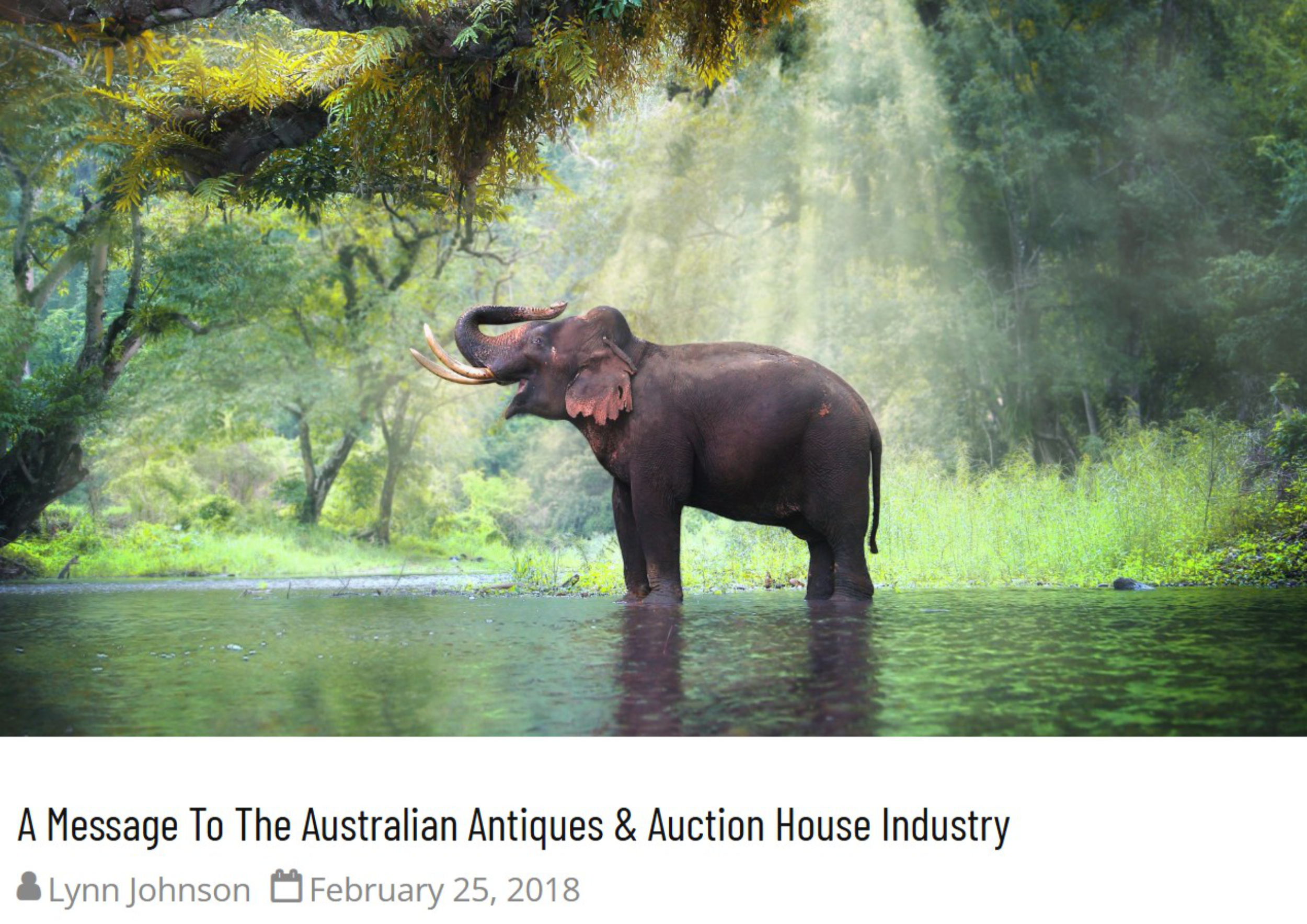
The same failure exists closer to home. Australia has known for years that its domestic market for elephant ivory and rhino horn remains a problem.
After conservation groups joined forces over years of investigations, lobbying and submissions to government, a 2018 parliamentary inquiry found bipartisan support for banning the domestic trade. In 2019, at CITES CoP18, the Australian delegation announced Australia’s intention to introduce domestic bans on elephant ivory and rhino horn.
Years later, the promised bans have still not been enacted. The Australian domestic trade remains.
At any point since 2018, the Federal Government could have drafted the necessary legislation and taken it to National Cabinet; all the evidence is that state and territory government would support the draft.
When representatives of the Federal Government were asked why this had not happened, the response was that they had “not had the resources to do so”.
This is the pattern we have seen repeatedly: The evidence accumulates. The problem is acknowledged. Commitments are made. Nothing changes.
The antiques and auction industries have certainly fought to maintain the trade. We have heard arguments ranging from concerns about losing customers who consign mixed collections containing ivory to the much simpler assertion: “We should be able to sell what we want.”
When New York reviewed its position on ivory sales, Sotheby’s and Christie’s supported stronger penalties and enforcement. But there is an obvious question. Who pays for enforcement?
The industry profits from the trade. The taxpayer pays for policing, investigation and prosecution when that trade facilitates illegal activity.
That is not a true-cost model.
The Federal Government has allowed the Australian market in ivory and rhino horn to remain open despite years of evidence and a publicly stated intention to close it.
If government wants to demonstrate that business interests do not determine environmental policy, this should have been low-hanging fruit.
The Uncomfortable Question
After years of working on these issues, the question is no longer simply: Why is there an illegal trade in wild species?
It is: Why are we so willing to fund the consequences of biodiversity loss while remaining reluctant to change the systems producing them?
We fund the rangers. We fund the iconic species. We fund the community projects.
But when it comes to changing the rules governing the trade itself, to pragmatically ensure it is sustainable and legal, momentum disappears.
That is the uncomfortable failure.
The conservation sector has become highly effective at managing the symptoms of biodiversity loss. It has been far less willing to confront the systems driving it.
And while we continue to manage the symptoms, the system keeps producing the disease.
The Window Is Closing
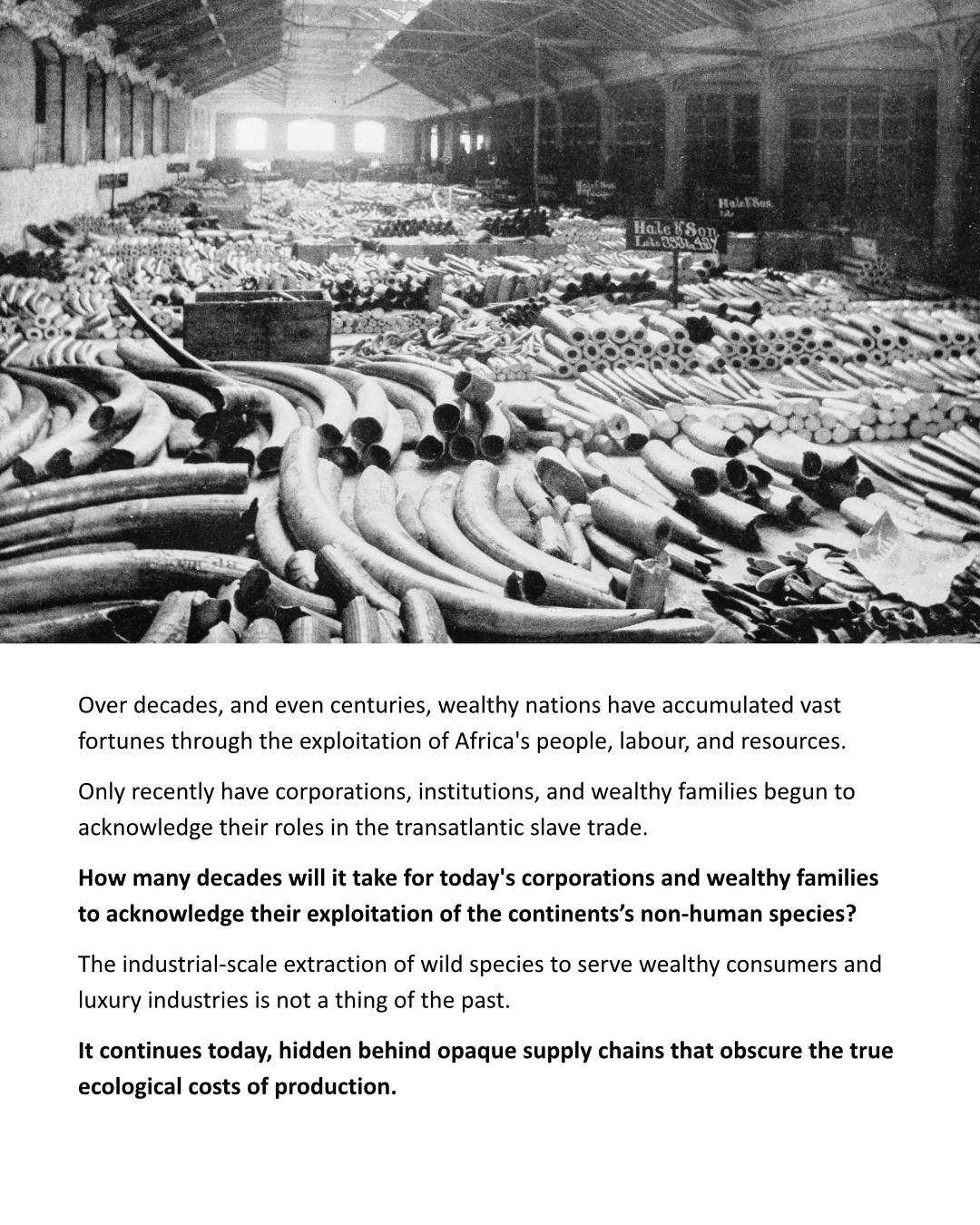
For decades, we have tried to regulate the consequences without confronting the system producing them. We have created offsets, credits, certifications, ESG frameworks and endless voluntary commitments; all solutions that allow the underlying economic model to continue largely unchanged.
But the wasted decades are catching up with us. Even good regulation, properly funded and enforced, may no longer be enough. The scale and speed of ecological degradation are accelerating faster than the institutions designed to address them.
The conservation conversation needs to move beyond elephants, rhinos, lions, forests and oceans—and towards the economic structures driving their exploitation: shareholder primacy, corporate power, limited liability, financialisation and the concentration of wealth and capital.
That is a much harder conversation. And after nearly two decades, I have seen little evidence that the conservation sector is either willing or able to have it.
We are still having essentially the same conversation about rhinos and elephants that we were having 20 years ago—while the economic system driving biodiversity loss continues largely untouched across tens of thousands of species.
If it takes another decade to have the same conversation again, it will be a conversation increasingly disconnected from the changes that are actually required.
Perhaps the more uncomfortable question is whether the sector cannot make this shift—or whether it will not, because doing so would require confronting the economic and political interests on which the conservation system itself depends.
Either way, we are accelerating towards a point where the ineffectiveness of the conservation world will become irrelevant.
Not because biodiversity loss will have been solved. But because the crisis will have accelerated beyond the capacity of the institutions created to tackle it.
The question is no longer whether conservation can become better at managing biodiversity loss. It is whether we can change the system driving that loss before there is too little left to save.
This will depend on whether the conservation sector is finally willing to confront the truths it has chosen to ignore, and the assumptions it has chosen not to test.
History will not be kind to those who promoted “sustainable use” without demanding that it be validated. Nor should it be.