

The 17th Conference of the Parties to the UN Convention on Biological Diversity (CBD) is underway in Armenia. While the official number of business delegates has yet to be published, attendance is unlikely to fall below the 1,261 business representatives recorded at COP16 in Colombia in 2024. For business, these conferences offer a valuable marketing opportunity.
But what if the glossy sustainability commitments, corporate partnerships and political declarations are less about protecting nature and more about greenwashing to maintain business-as-usual?
What if the root causes of why the CBD has failed to halt biodiversity loss since its inception, at the 1992 Earth Summit, are fundamentally the same reasons companies favour greenwashing over meaningful action to reduce their environmental impact?
Research has established that weak regulation and enforcement are the primary causes of companies engaging in greenwashing. This should come as no surprise.
Let’s be clear, the CBD is a UN convention with no meaningful enforcement authority; no country or business will face sanctions for not achieving any of the KMGBF targets and goals.
In this sense, the CBD is a primary example of a performative institution – that is it looks to the unquestioning eye like something is being done, whilst nothing is actually being done. The State of Biodiversity Action (SOBA) report published in the lead up to CoP17 is a global scorecard summarising nothing more than a signatory country’s ‘statements of intent’ towards achieving the KMGBF targets and goals.
After failing on ALL the 2020 Archi targets, is simply counting ‘commitments to action’ to the 2030 targets enough? Has the CBD learned nothing in 30 years of operation or was it never supposed to work?
Even The Guardian article on the first couple of days of the conference couldn’t ignore this fundamental problem, asking, Four years ago countries made a historic deal to save nature. Is it dead in the water?
The article states, “At the end of 2022, nearly every government on Earth committed to an ambitious deal to better protect the world’s rapidly disappearing biodiversity at a summit in Montreal, Canada”, continuing, “But four years later, governments look almost certain to miss nearly all of the deal’s targets – potentially continuing the record of never having met a single UN target on nature since the biodiversity convention was created at the Rio Earth Summit in 1992”.
Don’t get me wrong, I desperately want the CBD and all other environmental conventions and treaties to work. But wishing for success cannot compensate for a system designed to tolerate failure.
The Drivers of Greenwashing, a 2011 academic paper, identified three conditions that enable environmental deception: weak and uncertain regulation, organisational disconnects between marketing and operational performance, and ordinary human optimism. Greenwashing occurs when poor environmental performance is paired with positive environmental claims. In other words, the appearance of progress becomes a substitute for progress itself.
Over recent decades, glossy corporate sustainability reporting has become one of the most polished and expensive forms of marketing. Beautiful photography, aspirational targets and inspiring language create an impression of environmental responsibility. Yet beyond the presentation, what has actually changed? Across opaque supply chains, much of the claimed progress remains difficult to independently verify.
While they may not be quite as glossy as their business counterparts, the National Reports submitted to the CBD are greenwashing at country level. And the consolidated State of Biodiversity Action (SOBA) report is greenwashing on a global scale.
What’s Really Happening?
Companies pretend they are doing something useful to reduce their environmental impact or act ‘sustainably’, whilst not doing anything that would incur additional costs and reduce profits. Should we really be surprised about this given the 1970s shareholder primacy doctrine? Businesses are fully in thrall to the shareholder primacy doctrine and even if executives would care about the environment (most don’t), they couldn’t really act on that.
Governments are under pressure from the public to stop environmental destruction and biodiversity decline, but they are constrained by the power of business and the billionaire class to not pass any stringent regulations that would impose substantive costs on business, reducing both economic growth and corporate profits. Hence politicians and governments prefer the performative nature of the CBD, its non-binding targets, and the equally performative CoP events every couple of years over any real action to address the biodiversity crisis.
The compromise is predictable. Businesses offer reassuring sustainability claims; governments announce ambitious targets; and the public receives a hopeful narrative. Shareholders retain their returns, while the underlying drivers of environmental destruction remain largely untouched. Greenwashing is not an unfortunate flaw in this arrangement. It is a rational response to incentives that reward the appearance of responsibility while allowing business as usual.
But for the deception to hold in the medium-term, regulation and enforcement must be weak.
If companies can make unsubstantiated sustainability claims without the fear of running afoul of stringent regulation, a powerful regulator and well-resourced enforcement, then the risk is low and the net benefit of engaging in greenwashing pays off.
When unsupported environmental claims carry little risk, greenwashing can be commercially advantageous. Exposures by whistleblowers, journalists or researchers may embarrass a company, but the familiar response is often public relations damage control, promises of improvement and partnerships with conservation organisations that lend credibility to corporate claims. The damage to a company’s brand is short term, if it happens at all.
The problem, therefore, is not simply greenwashing or the performative nature of the CBD. These are symptoms of deeper structural failures: a neoliberal economic model built around endless growth, shareholder primacy and the concentration of corporate power, including its influence over governments and regulation.
We need to stop focusing exclusively on second-order effects and confront the root causes.
This challenge extends to the conservation sector, which has fully bought into the limits imposed by the neoliberal order. As such much of their work simply documents decline, the havoc overextraction for profit wrecks on the natural world. In a small number of instances, they document a species that bounces back from the brink, fulfilling the “ordinary human optimism” need that things are working.
But documenting destruction and celebrating isolated successes are not substitutes for changing the systems that enabled destruction in the first place.
If business and governments can greenwash, then why not the conservation sector itself? It does, with the long-standing promotion of the sustainable use of wild species. The model is too often defended through ideology, wishful thinking and optimism rather than robust, independently verifiable evidence.
Consider the 2024 paper The Positive Impact of Conservation Action, which assessed the effectiveness of conservation interventions. Its 33 authors screened more than 30,000 potentially relevant publications and identified 186 studies evaluating the impact of conservation interventions over the previous century. Yet, for sustainable use of species, the evidence was inconclusive. Only five relevant publications could be from the 30,000 filtered.
This is a striking finding. After decades of promoting sustainable use as a conservation solution, it was obvious the authors tried very hard to find the ‘evidence base’ but it simply didn’t exist.
When there is no investment into proving the sustainable use model, then all it has ever been or will continue to be is greenwashing. The tragedy is that this has aided companies retain access to the wild species ‘raw materials’ they need for their production and profit.
Transparency About Uncertainty
In recent weeks a new guide has been published for companies on how to restore credibility. The authors conclude companies must tackle greenwashing by identifying and being transparent on their levels of uncertainty.
The two forms of uncertainty that undermines accurate disclosure (including greenwashing about biodiversity loss and environmental commitments) being:
- Effect uncertainty – does the action actually produce the intended outcome?, and,
- Measurement uncertainty – can the outcome be accurately and consistently quantified?
Only if both effect and measurement uncertainties are low can the reported outcome metrics and statements be credible.
If both uncertainties are high, publishing anything under the guise of being sustainable is inaccurate and misleading. It isn’t only about disclosing sustainability claims but also being able to defend them.
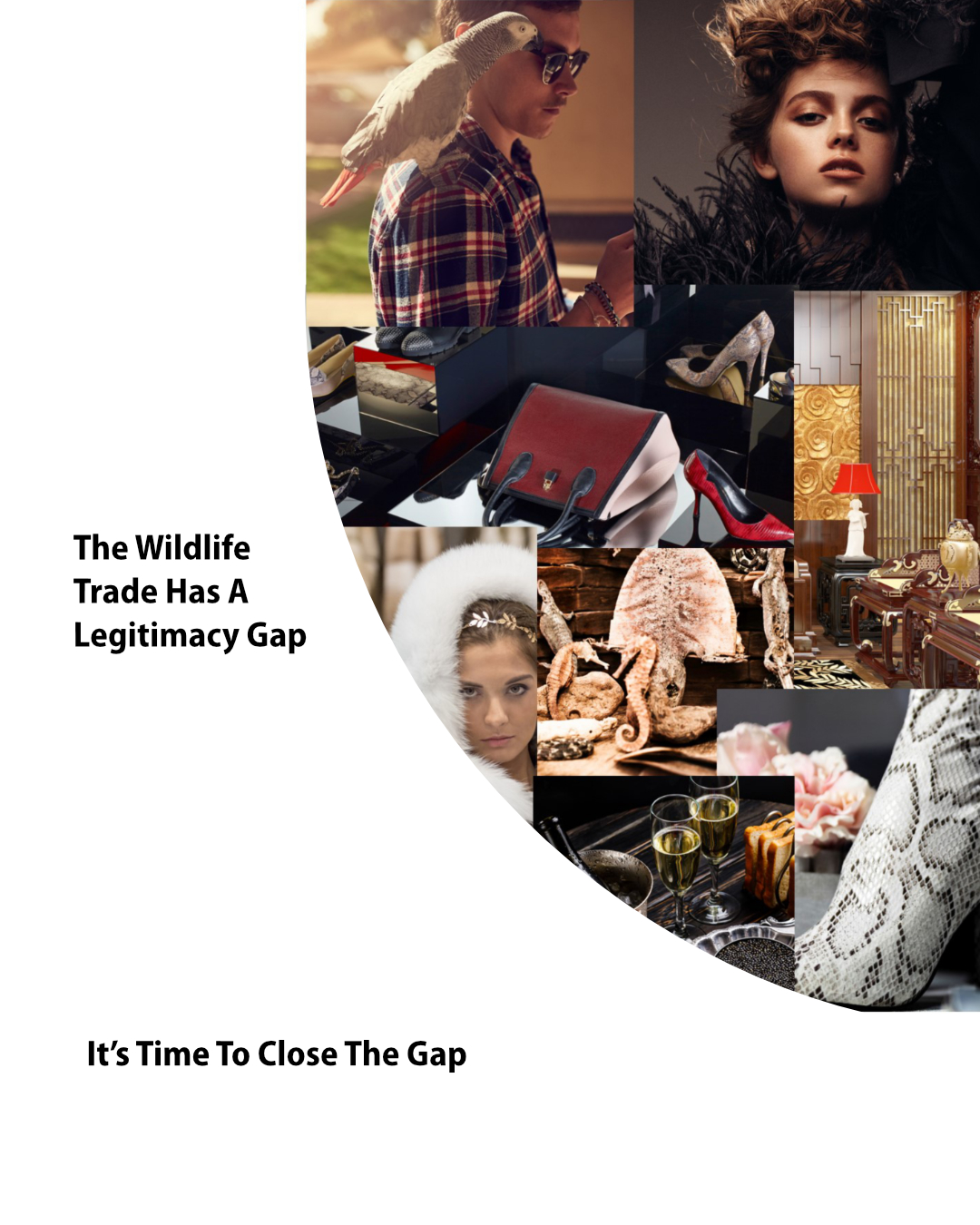
These uncertainties are deeply ingrained in the global commercial legal trade in wild species, including endangered and exotic species. It is only weak regulation and enforcement that has enabled the deception to hold for decades.
As an example, the CITES has been left to languish in obsolete, analog systems, dating back to the 1970s, and its yearly operational budget has not increased for 25 years, from around US$7million. All this while it is supposed to effectively manage a global international trade in wild species valued at over US$300 billion annually. This is the perfect scenario for greenwashing to flourish and, hiding in plain sight, it certainly has.
Modernising regulation and enforcement would help expose this global business scandal. It would also force conservation organisations to confront an uncomfortable question: what happens if rigorous evidence fails to support the sustainable-use model they have spent decades endorsing?
And for the CBD, whose 3 main objectives include the sustainable use of the components of biological diversity, it must stop rewarding the appearance of environmental responsibility and start demanding demonstrable results. The answer cannot be to preserve reassuring narratives at the expense of transparent, detailed and genuinely relevant scrutiny.
Greenwashing is the predictable outcome of a system that rewards environmental claims, yet is based on weak regulation and accountability, and protects the economic incentives driving ecological destruction.
Until those foundations change, we will continue to confuse promises with progress, and spend billions managing the consequences of a system we refuse to challenge.