

The conservation sector continues to tie itself in knots to avoid accepting the obvious solution to overcome unchecked commercialisation of wild species and its tragic consequences.
The publication of a paper this week titled, The True Scale Of Global Wildlife Trade Is Obscured By Data Gaps, which found that over 107,000 species are affected by trade, more than twice the number estimated seven years ago in a key IPBES analysis into biodiversity loss, has reignited the debate around wildlife conservation.
But this invisible harvesting and exploitation is not simply a gap in data. It is a failure of commercial governance and accountability. Yet the paper didn’t ask the obvious question, would these 60,000+ species have gone unrecognised for decades, even when under threat from trade, if CITES had been moved to a reverse listing model during the 1980s?
The single most obvious solution, and one that was first proposed in 1981, is that those who want to profit from the trade in wild species must prove up front that they can manage offtake and trade to ensure it is sustainable and legal. In addition, profiters must pay all the costs of monitoring and regulation.
Doing the work upfront to prove a trade can be managed ‘safely’, before trade is approved, is done in all industries (to a greater or lesser degree) other than the trade in wild species.
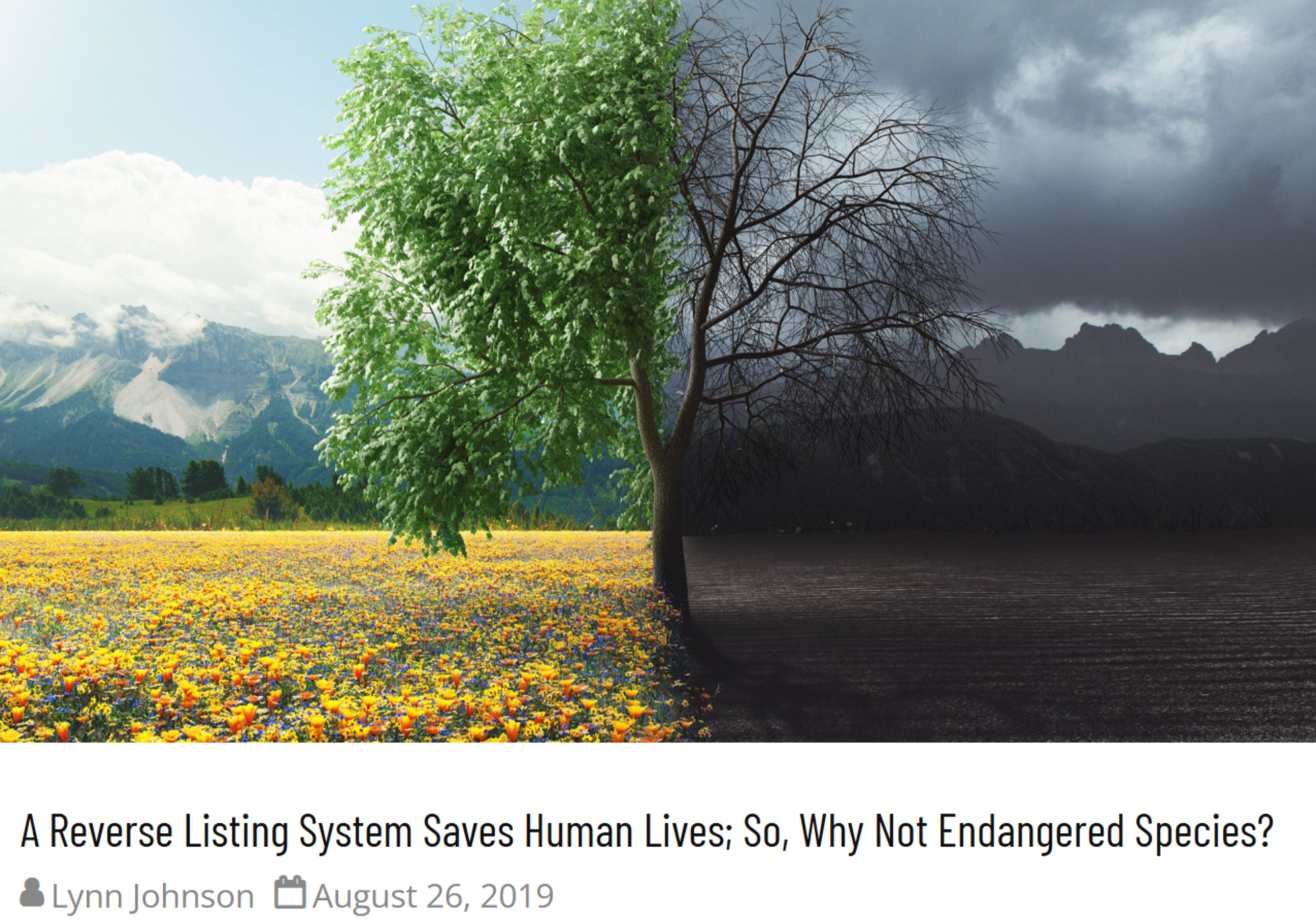
As I read this new paper, I find my mind transported back to CITES CoP18, in 2019. Sitting in one of the sessions I wrote an article posing the question, if a reverse listing system of trade can save human lives, why is it not being implemented to save wild species from overexploitation for commercial trade?
After 2 years of deep diving into the CITES trade system, I was with colleagues in Geneva in 2019 to understand how the reverse listing model had fallen off the conservation agenda after it was first proposed in 1981 at CITES CoP3.
At the time a few organisations had started proposing a reverse listing model as a solution to the rampant exotic pet trade. But the question was, why wasn’t reverse listing being considered for ALL industrial scale commercial trade in wild species, which would including timber and fisheries?
A reverse listing – where the burden of proof falls on those who profit – is an eminently sensible approach. Yet in discussions with many from the conservation world over the two weeks of CITES CoP18, the colour visibly drained from them when the reverse listing approach was discussed.
Imagine if the pharmaceutical industry operated like the wildlife trade. A pharmaceutical firm could develop a new drug, manufacture it and legally sell it without laboratory testing, human trials or regulatory approval.
Only after the drug was on the market, and people began suffering serious side effects and dying, would anyone investigate whether it was safe.
Those concerned about the consequences would have to scrape together funding from donors to research the harm, collect evidence from around the world and document the deaths. They would then have to provide evidence upon evidence to justify their concerns. Meanwhile, the pharmaceutical company would face no equivalent obligation to prove its product was safe.
Imagine, too, that the system monitoring the manufacture, distribution and sale of drugs was paper-based, disconnected from customs, riddled with known flaws and had undergone just one major review in 44 years.
Every three years, regulators would meet to review the mounting evidence of harm. Despite clear warning signs, their response would be to commission another three years of research before considering whether to restrict or stop the sale of the drug.
Would we accept this? Would we allow pharmaceutical companies to trade first and prove their products safe only after people had suffered or died? No, of course we wouldn’t, because it would be a ridiculous approach, right? But we accept this very system for the trade in endangered species.
The pharmaceutical industry must apply the precautionary principle, investing in research and demonstrating safety before a product reaches the market. In effect, this is a reverse-listing approach: prove it is safe before permission to sell is granted. For wildlife, the default is the opposite. Commercial trade is permitted until sufficient evidence of harm has been assembled to justify restrictions.
Trade first. Ask questions later. And by the time we have enough evidence to act, the damage is likely already done.
Given the default of the trade in wild species is to trade until it can be proven it is unsustainable, why does it come as such a surprise that this latest research found that more than twice the number of species are affected by trade than was previously estimated? Until recent years there has been little effort by to systematically investigate the legal trade. And, even when a species is flagged as a concern it takes on average 12 years to be listed on the CITES for trade restrictions.
This predicable mess was the reason why in 1981 a move to a reverse listing model was proposed. So, back to the question, would these 60,000+ species have been ignored for decades if CITES had been moved to a reverse listing model during the 1980s? Unlikely.
The 1981 submission highlighted the concern that for too many species there wasn’t a sufficient level of knowledge, management and control to ensure that the proposed trade will not threaten the species survival. In addition, the Australian proposal correctly recognised that the continuing addition of species to the appendices under the direct listing model would lead to immense practical difficulties in identification and enforcement at customs.
So why now, 45 year later, when the scale of biodiversity loss makes it clear that global systems have failed, are conservation NGOs and academics (still) jumping through hoops and (still) tying themselves in knots to do ANYTHING BUT move the CITES to a reverse listing (and profiter pays) model for ALL wild species. Have they even realised how blinkered they are to using the reverse listing process? After all, it is nothing more than a real-life implementation of the precautionary principle.
Is it because they can’t bring themselves to admit they were wrong 45 years ago, when they first capitulated to the corporate world to maintain the exploitative style model that came into force in 1975?

Sadly, it is much worse than that. Why? Because in a world that has changed beyond all recognition in the last 45 years, no one has had the courage to say, “does the CITES convention need a strategic review to ensure it is still valid for today’s global trade conditions and volumes?”.
That’s right, the CITES convention itself has had only one strategic review in its 50+year history, and this is to the shame of the conservation world. If they had shown the courage at any point in last 45 years to say, “given wildlife populations are collapsing, you know what maybe we should review if the CITES convention is still working and put all the options on the table, including reverse listing, to ensure that we have the best system to validate sustainability and legality of the trade”. In 45 years, they couldn’t pluck up the courage to do this.
So why is the conservation sector finally looking at something it has avoided doing for decades? As with the extreme weather events circling the globe due to climate change, in the coming decade they know that the public are going to catch on to the scale of the crisis created by biodiversity loss.
There will be greater scrutiny of why the conservation sector has ignored a significant driver – direct exploitation for commercial trade – for too long.
What’s the evidence of this increased scrutiny? While the CITES is generally ignored by the media, the CBD isn’t, and none of the attention it is getting is good, and rightly so.
Possibly The Guardian, of all the mainstream media, said it most clearly, “At the end of 2022, nearly every government on Earth committed to an ambitious deal to better protect the world’s rapidly disappearing biodiversity at a summit in Montreal, Canada”, continuing, “But four years later, governments look almost certain to miss nearly all of the deal’s targets – potentially continuing the record of never having met a single UN target on nature since the biodiversity convention was created at the Rio Earth Summit in 1992”. Not a great endorsement of the global conservation industry.
At the recent World Environment Forum at Davos in June 2026, keynote speaker Becky Chaplain Kramer, the global biodiversity lead scientist at the World Wildlife Fund said, “We have to measure real outcomes and be willing to report our failures. Because failures, I know we all say this, failures provide the most valuable lessons, but we need to believe that because right now we bury them.”
This is true, and even WWF only quote figures about the legal trade of wild species on their website from the early 1990s – so much for the evidence-based mantra of the conservation world. But WWF is not alone, almost all conservation NGOs and academics have buried their failure regarding the unsustainable exploitation in the global legal trade.
At CBD CoP17 one of the discussions happening was “does science have an image problem”.
For anyone who is taking notice of biodiversity loss associated with direct exploitations, yes, it does and so it should.
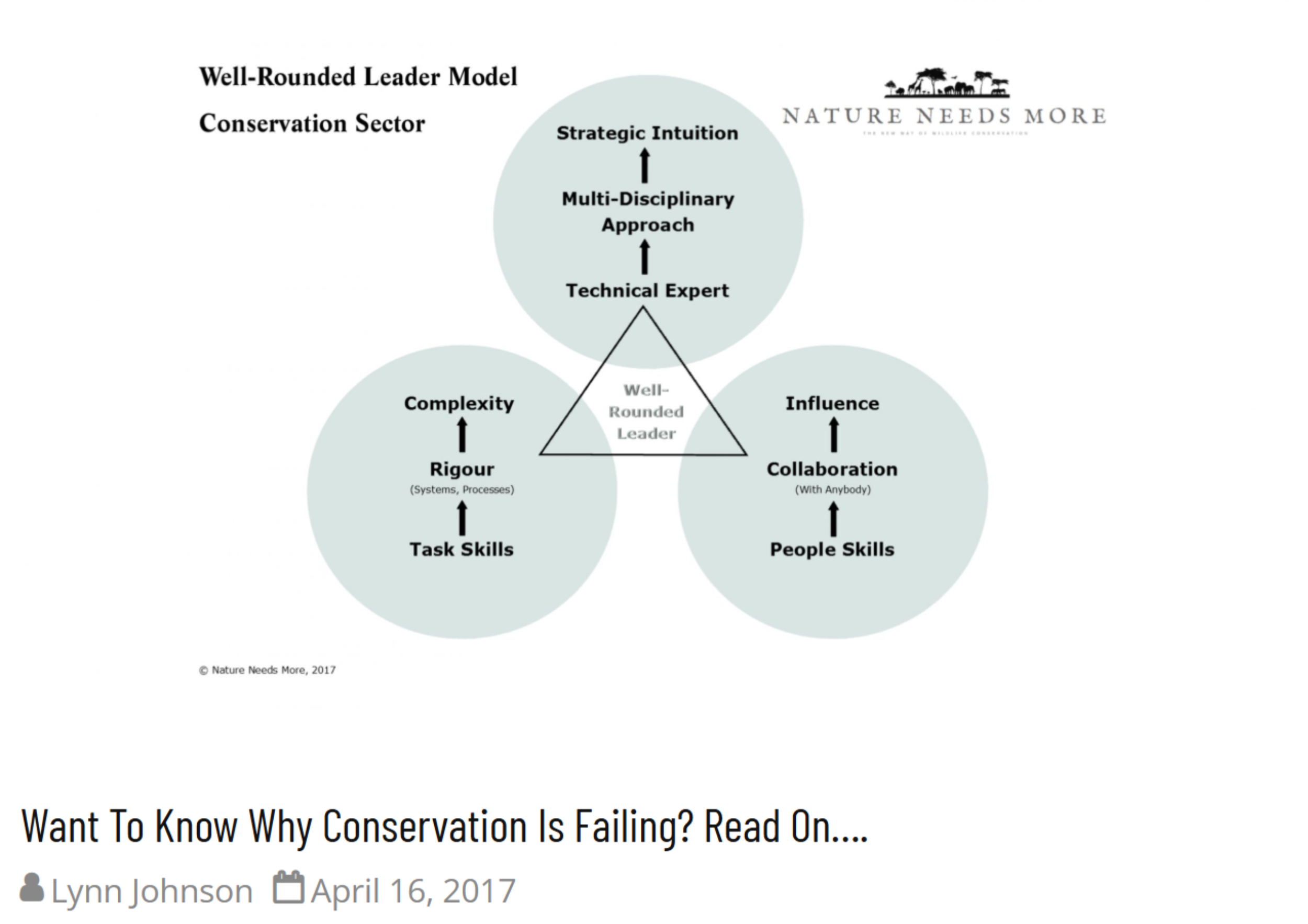
If the conservation sector’s hubris and blinkers mean that it will continue to bury its failures and ignore obvious solutions to the industrial extraction of wild species it will remain on its path of irrelevance.
Has conservation even realised that it has shot itself in the foot with this new paper?
When it comes to the industrial scale, global commercial trade in wild species, the conservation world seriously fucked up. For the sake of the species who depend on them for their survival, I hope they can finally overcome their need to bury their failures and stop tying themselves in knots, so these failures don’t come to light. They are trying so hard to create a less effective Plan B because they are desperate to keep Plan A – a reverse listing/profiter pays model – off the radar.
Finally, they must stop doing the bidding of stakeholders who prefer a decentralised approach and hence making supply chain transparency and accountability harder to achieve. It is so easy for business to greenwash in a decentralised system.
To drive the changes needed the conservation sector would need to:
- Accept a comprehensive strategic review of CITES. Examine whether a convention established in the 1970s is fit for the realities of today’s globalised, industrial-scale wildlife trade. All regulatory models should be considered, rather than simply trying to improve the existing system.
- Be genuinely open to considering the reverse listing model for commercial wildlife trade, not just do some minimal research with weak arguments that seem more about closing the reverse listing discussions down. For example, an October 2025 publication, supposedly assessing the feasibility, risks and benefits of adopting a reverse listing approach for CITES was based on a fundamental flaw. It states that CITES uses permits and quotas to “ensure legality and sustainability” of trade in listed species; the starting point is portraying that the CITES works, when it clearly doesn’t. The authors also raise concerns about the feasibility and risks of “radical system change”. They say that reverse listing can’t work without resourcing, while ignoring that the current system is impoverished to the point of being meaningless. They also discuss that moving to a reverse system will be hard because 40,000 + species are listed for trade restrictions, overlooking an important historical point that reverse listing was dismissed as unnecessary because CITES then restricted trade in only around 700 species. Instead, the problems were ignored for nearly 40 years, only for reform to be now characterised as too difficult. You can’t have it both ways.
- Accept prior authorisation must be the default requirement for commercial trade in wild-harvested and captive-bred species is a pragmatic approach – this means doing something much better than the highly inadaquate non-detriment finding process currently used (or not as is not often the case). It is not untoward to believe that those seeking to profit must demonstrate legality, traceability and sustainability before trade is permitted.
- Recognise a profiter-pays principle is a way to help overcome the regulation funding crisis. As with other industries the trade in wild species must require commercial operators to contribute to the full costs of monitoring, independent verification, and regulatory enforcement. Contributions should reflect the scale and profitability of their activities.
- Have a mandatory enforcement authority. Strengthen CITES institutional requirements by ensuring that enforcement is not an optional or inadequately resourced component of national implementation. You have to question if there was really any point in creating the CITES given an enforcement authority wasn’t made mandatory from the start, as the management and scientific authorities were!
- Commit to the validation of sustainable use. Don’t promote it if you can’t prove it, and currently the sustainable use model remains unproven. All assumptions, and the associated wishful thinking, need to go.
- Help lobby for a modern digital, and global CITES permitting because currently this trade lives in the analog world of the 1970s. It is difficult to reconcile the fact that the conservation world ignores the CITES paper-permits system while in parallel promoting the need for interoperability of customs reporting systems etc!
The conservation sector has spent decades documenting the decline of wildlife populations, campaigning for stronger protections for the illegal wildlife trade and trying to manage the consequences of commercial exploitation.
Yet it has largely failed to confront the regulatory architecture of the legal trade system that allows this exploitation to continue without adequate oversight. Finding the additional 60,000+ species traded, that were previously missed, exposes just how extensive that failure has become.
More than 107,000 species are being affected by trade. It is unfathomable that the conservation world has been willing to accept this for 45 years when a solution to this could have been implemented in the 1980s.
We cannot continue to pretend that better data, more research, and incremental improvements to existing flawed systems will solve a problem rooted in the regulatory model itself. Even the precautionary principle outlined at the 1992 Earth Summit made it clear that where “there are threats of serious or irreversible damage, lack of full scientific certainty shall not be used as a reason for postponing cost-effective measures to prevent environmental degradation.” Yet calling for more data, better data, integrated data, consistent data is all to often the go-to conclusion of conservation research.
The solution is not complicated. As with other industries, those who want to profit from commercial exploitation of wild species must first demonstrate that they have all the systems and resources in place to manage this legally and sustainably. They also have to pay for the independent monitoring and enforcement needed to validate what they are doing is working.
That proposal was tabled for the trade in wild species in 1981.
Forty-five years later, perhaps the most uncomfortable question is not why we still lack the data to understand the scale of global wildlife trade, but why the conservation sector has been so reluctant to challenge the system that created the problem.
The model needed to fix this exists and is used in multiple other industries. The conservation sector must get over the fact that it failed to push for a reverse listing model 45 years ago. Until it does it will continue to tie itself up in knots to create a system that will be significantly inferior and has much less of a chance of saving wild species from commercial exploitation.
It is not enough to call for better monitoring along the full supply chain. The expectation must be that the regulatory system cannot allow commercial exploitation to proceed without first requiring proof that sustainability and legality can be effectively and transparently managed.
Wild species cannot afford another 45 years of institutional hesitation and academic blinkers.